

Posts Tagged ‘Spider-Man’
The Gamma Gambit (1979)
Normally today has been reserved for National Dog Day on this page.
We’re gonna shake things up a bit this year and go with another day that shares this date: National Toilet Paper Day.
This underrated invention is taken for granted – until there is none and always at the most inconvenient of times. People have used many methods to clean themselves. The Romans used a sponge on a stick that they rinsed and left for the next person.
Early American settlers used whatever was handy; leaves, grass, corn cobs, fruit skins, seashells, stone, sand and water were the most common depending on location and social customs.
China first mass produced toilet paper in the 14th century.
Americans can rejoice and celebrate 1857, the year toilet paper first hit store shelves in the new country. It was sold on the roll in 1871. Leave it to the Germans to improve upon the product by adding perforations to the roll allowing for squares.
It wasn’t until 1883 that Seth Wheeler patented rolled toilet paper and toilet paper dispensers.
To liven the invention colors were added in the 1960s. Those lasted till the turn of the millennium when basic white has become the norm again. The last colored toilet paper was manufactured in 2004 by Scott.
This non-holiday is very important to the United States, as we use more toilet paper than any other country in the world. America is also, surprise, surprise, the leading exporter of the product.
A whopping 75-percent of the world doesn’t use toilet paper. Many other countries have moved onto the bidet.
Rather than having a spokesman for the day, we’re using toilet paper itself. Or, a specific roll.
As Marvel Comics pushed through the end of the 1970s and sluggish sales, merchandising continued to prove an important source of revenue. One of those licenses was snapped up by Oh! Dawn Inc. of New York. Their offering to the comic book collecting world?
The Incredible Hulk and Amazing Spider-Man Toilet Paper with an original story: The Gamma Gambit. The quality tissue provided 40.65-square feet of two-ply; 325-facial quality sheets.
The Gamma Gambit, as written by Jim Salicrup and illustrated by Michael Higgins, is told over eight sheets and repeated until roll’s end.
The jokes tell themselves, so why belabor the point?
If interested, try an online selling site to purchase this on the secondary market. It’s worth picking up for the novelty alone. Just make sure to put it under some mylar with a sign that reads: Do Not Break, Even in an Emergency.
-
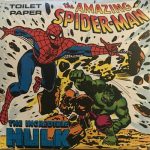
- The Gamma Gambit
-
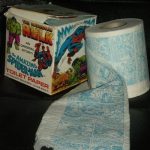
- The Gamma Gambit (1979)
-
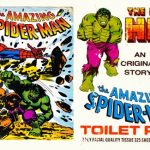
- The Gamma Gambit (1979)
Amazing Spider-Man (2018) 50
Commemorating the month and its rich history of horror comic books, Marvel took October 2020 to offer readers variant covers to their current favorite reads with a frightful flavor of titles past.
Aaron Kuder illustrated the variant for Amazing Spider-Man 50 with lush coloring from Jordie Bellaire. Spidey took on the Blade, the Vampire Hunter persona in this Spider-Man the Vampire Hunter homage.
Only the cover reflects Marvel’s horror heritage. The issue offers part one of the Last Remains storyline.
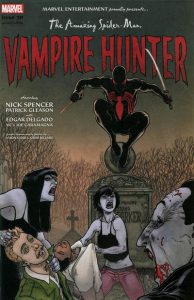
Amazing Spider-Man (2018) 50 Aaron Kuder variant
While Spider-Man has faced his share of supernatural personages, he’s only really associated with Blade, the Vampire Hunter through the highly acclaimed 1990’s Spider-Man: The Animated Series.
Blade was introduced as a supporting character in Marvel Comics’ The Tomb of Dracula (1972) issue 10. He would continue to guest in issues 11 through 21 and again in issues 24 and 28.
Marvel Scribe Steve Gerber liked the character well enough to utilize him in Adventure into Fear issue 24 that same year appearing opposite Morbius the Living Vampire.
His first solo outing came in December of 1974 in an 11-page story in Vampire Tales. Co-creator Marv Wolfman penned the tale. He returned the following book before earning a book-length story between the pages of Marvel Preview number three. Chris Claremont was the author.
Wolfman continued Blade’s legacy in Preview issue eight in 1976. It would be his last appearance in the Marvel Universe for over a decade.
As Marvel tested the darker waters of in the early 1990s, Blade was brought back in Ghost Rider (1990) 28. His popularity was such he earned a co-starring role in the book Nightstalkers that ran 18 issues.
That led to his own title that lasted 10 issues followed by a one-shot in Marvel: Shadows and Light.
As he prepared for the big screen, Blade starred in two solo one-shots, Blade: Crescent City Blues in 1998 and Blade: Sins of the Father the following year.
Blade would bounce around the Marvel U for a time before starring in another short-lived solo series from 2006 to 2007.
Since then, the character has been relatively quiet yet, with three theatrical released films, a one-season television series and numerous appearances in the animated world, Blade has been resilient.
Amazing Spider-Man (1962) 140
National Administrative Professionals’ Day has a pedigree stemming from U.S. Secretary of Commerce Charles Sawyer from way back in 1952.
Sawyer proclaimed June, though a month, National Secretary’s Day with June 4 set aside as the official day of celebration. With the new millennium, the name was changed to a more gender-, politically correct-friendly observance of Administrative Professionals Day and moved to April.
Today was designed to recognize the efforts put forth by the otherwise unsung heroes of the office. It recognizes the work of secretaries, administrative assistants, receptionists as well as offering umbrella coverage to all administrative support professionals.
Celebrate by rewarding those mentioned above with more than their paycheck. Some suggestions include flowers, gift certificates, gift baskets, candy or lunch.
Putting a face to the day is Gloria Grant.

Amazing Spider-Man (1962) 141
Ms. Grant first graced the pages of Amazing Spider-Man 140 as Peter Parker’s neighbor. Her initial appearance is little more than five Ross Andru panels barely hinting at the role should would soon attain in the title.
With her modeling career on hold and needing work, Peter was able to find her employment at the Daily Bugle during Betty Brant/Leed’s honeymoon.
Grant would become more than just a supporting character when she fell in love with gangster Eduardo Lobo. The romance came to an end when she accidently shot Lobo while aiming at Spider-Man.
Later, she helped Spidey and a government agent capture voodoo witch Calypso. Her involvement with boss J. Jonah Jameson and the Spider-Man titles would end when she left JJJ’s mayoral staff after he was elected as mayor of Manhattan.
For those in the work setting with administrative professionals, mark the day on your calendar. Those on the other side the desk, don’t for forget to drop a hint just in case.
Just remember, National Boss’s Day is Oct. 15.
Amazing Spider-Man (1963) 210
Welcome back for the second celebration of World Braille Day.
World Braille Day is held Jan. 4 each year recognizing the importance of braille as a way to communicate. The day reflects the birthday of its creator Louis Braille.

Amazing Spider-Man (1963) 210
Our host for the day is Cassandra Webb, aka Madam Web. Her first appearance predates National Braille Day by 39 years using the cover-dated Amazing Spider-Man 210.
The elderly clairvoyant and precognitive mutant suffers from myasthenia gravis leaving she attached to a life-giving chair resembling a spider web.
When Denny O’Neil and John Romita, Jr., first envisioned her, she was little more than an enigma helping Spider-Man with her visions. She proved popular enough after her inaugural appearance, and returned in Amazing Spider-Man 216 to help stop an assassination plot.
She was firmly entrenched in the Marvel Comic Universe by the two-part Nothing Can Stop the Juggernaut in issues 229 and 230. During the short story arc, Spider-Man attempts to save Madam Web from the Juggernaut as he stomps through town.
In the end he finds he cannot and Web nearly kills her when the villain disconnects Web from her life support system.
Madam Web continues to live in the MCU making periodic appearances.
Outside of the printed page she guest-starred in Spider-Man: the Animated Series. She was voiced by Joan Lee, wife of Stan Lee.
For more information on the non-holiday, please refer to last year’s post with Deadpool’s Blind Al.
Spider-Man, Fire-Star and Iceman at the Dallas Ballet Nutcracker (1983)
Spider-Man and His Amazing Friends was in its third and final season when Marvel and the Dallas Times Herald teamed again for this mash up of Texas transgression.
Peter Parker and Bobby Drake have accompanied their soon-to-be former team mate, Angelica Jones, to her new home in Dallas, Texas.
While there, the trio decide to take in the Nutcracker as performed by the Dallas Ballet. Peter’s Spidey sense jangles as the three stand outside the theater. Investigating, they soon discover the nefarious plot to disrupt the performance by stealing the props.

Spider-Man, Fire-Star and Iceman at the Dallas Ballet Nutcracker (1983)
Daddy Longlegs, a mercifully one-and-done villain, is found to be responsible. His plan is dismantled by the threesome leaving Daddy Longlegs high and dry on an ice pillar.
Peter, Bobby and Angelica attend the performance which is spelled out by writer Jim Salicrup and illustrated by Jim Mooney.
This teaming of Marvel and the Dallas Times Herald was the last. Already they two had collaborated with a back-to-school edition (Pipeline Peril) and Dallas Cowboy cheerleaders- special (Southwest Showdown) featuring Spidey and the Hulk, Web Head and the Dallas Cowboys (Danger in Dallas) and Spider-Man on his own against the Kingpin (Christmas in Dallas).
The Dallas Times Herald suspended publications in 1991, officially closing its doors December 8 of that year.
Spider-Man and His Amazing Friends aired from 1981 to 1983 on NBC Saturday mornings. It would continue in reruns for another two years.
In its second season, Spider-Man and His Amazing Friends accompanied the Hulk cartoon billed as The Incredible Hulk and the Amazing Spider-Man. Stan Lee began narrating during the second year.
Season one featured 13 episodes, while season two only aired three – each featuring the origin of the three heroes – and the third and final season showcased eight new shows.
Amazing Friends became the launching pad for new mutant Angelica, known as Firestorm. She would debut in comic continuity in Uncanny X-Men 193 in 1985 followed by a four-issue mini-series.
Prior, a Spider-Man and his Amazing Friends one-shot was released in 1981. The book loosely adapted The Triumph of the Green Goblin animated episode. It is not considered part of the canonical legend.
The series opened the original MCU featuring an unprecedented cast of co- and guest stars including the Black Knight, the X-Men, Loki, Shocker, Shanna the She-Devil, Beetle, Mysterio, Red Skull, Thor, Magneto, Juggernaut, Sunfire, Captain America, Daredevil, Hulk, Iron Man, Namor, Doctor Strange, Dr. Doom, Chameleon, Electro, Green Goblin, Kingpin, Doctor Octopus and the Scorpion.
The Red Skull episode has been deleted from the Disney+ schedule due to the portrayal of Nazi swastikas and the phrase “Heil Hitler.”
The idea of Amazing Friends would be resurrected throughout the next few decades. In Spider-Man Family: Amazing Friends (2006) issue one, a back up story, Spider-Man and His Amazing Friends Co-Workers, was included for the 25th anniversary of the animated series.
Brian Michael Bendis gave the series a nod in Ultimate Spider-Man. The cover of issue 118 paired Spidey, Iceman and Firestorm. Rather than Angelica, Bendis used cast member Liz Allan.
So, unless a traditionalist, give the Nutcracker a pass and relax with some animated Marvel goodness.
Spider-Man Drakes Cakes Mini Comics Series 1 (1993)
So many holidays, so much food.
Coming on the heels of Thanksgiving and just in time for the confectionary crush of Christmas time is National Cake Day.
Cake originates from the Viking kake. While the word has remained relatively the same, the end result has differed. Originally, cake was a flat bread with a regular shape flipped to ensure both sides were baked evenly.
The first ever birthday cake dates back before 1785. The term referred to a cake gifted for a birthday.
It wasn’t until the 19th century cake became what we know it as today. Cakes could then be baked with extra refined white flour and baking powder instead of yeast. Buttercream frostings began replacing boiled icings with fruit toppings.
A history of National Cake Day is not as easy to find. All we know is its as good a (non) holiday as any. Better than others in that National Cake Day allows celebrants an excuse to enjoy a sweet pleasure they may have avoided that day.
Our comic book representation for the day is the four-issue mini offered by Drakes Cakes in 1993 starring a line up Marvels’ finest – and most popular at the time.
Drake’s Cakes are named after founder Newman E. Drake who started the company in 1896 in New York.
The National Biscuit Company, better known now as Nobisco, bought out the Drake bakery and referred to the bakery as the N.E. Drake Baking Co. The Drake’s Famous Loaf Cakes continued to sell under the brand name until 1902. The Drake Baking Company was dissolved in 1903.
Drake reestablished his business as the Drake Brothers Company in 1903 and had expanded to a five-story bakery in 1913.
The company remained a family business until 1998 when Interstate Bakeries Corporation purchased the brand. Drakes became part of a Bakeries line that included Hostess.
Hostess Brands Inc., formerly Interstate Bakeries, filed for bankruptcy in 2012. In April of 2013, McKee Foods purchased the Drake’s brand for $27.5 million, reintroducing the company’s top selling items the same year.
Amid the shuffling of ownership, Drake partnered with Marvel Comics to publish four mini-comic books (3”x5” and 16-pages long) featuring Spider-Man, Hulk, Silver Surfer, Jubilee and Wolverine. Together they faced off against the Rhino, Sabretooth, Juggernaut and Doctor Doom.
Titles included Spider-Man: Carnage on Campus, Wolverine: Danger on the Docks, Hulk: Mayhem at the Mount and Silver Surfer: Lunacy in Latveria.
Unlike many of the other promotional giveaways, these were free of product placement. Only the last page touted the remaining comic books in the series, courtesy of Drakes Snack Cakes! A one-page add for the product was featured on the back cover.


Sylvan Learning Systems: Spider-Man Battles Ignorance (1992)
For those who aren’t in the know, Diwali is a real holiday; the largest and most important in India and one that may become part of the American tradition.
Diwali celebrates victory of light over darkness and knowledge over ignorance. It is a five-day festival of lights usually celebrated in the fall.
Congresswoman Carolyn Maloney (D-NY) has introduced a bill – Deepavali Day Act (H.R. 5904) for Diwali to be recognized nationally as a federal holiday. Currently the bill to recognize the Hindu new year has over 30 sponsors.
Diwali has been celebrated for more than 2,500 years.
To celebrate, we’re offering up a Sylvan Learning Systems sponsored spin on battling ignorance – hence the title.
After our hero has his mind wiped by the Mad Thinker, he finds help at a Sylvan Learning Center. Spidey is served a heaping helping of propaganda from students and teacher as they restore his memory enough to tackle the second-rate villain.
Using what he’s learned at the center, Spider-Man is able to defeat the Thinker and return his missing memory. A final farewell and thank you to those who helped him, Spidey swings into the sunset.
This $1.25-valued comic book giveaway featured a self-aggrandizing learning franchise as written by George Caragonne with illustrations by Alan Kupperberg. Sylvan Learning began in 1979 focusing on corporate supplemental learning centers focusing on personalized instruction in reading, writing, math skills, study habits, homework support and test preparation.

Sylvan Learning Systems: Spider-Man Battles Ignorance (1992)
National Video Game Day
Not to be confused with Video Game Day, National Video Game Day is held Sept. 12 each year allowing the armchair enthusiast their day in the sun – so to speak.
Most video game historians consider 1971 the dawn of video games. In 1971 Computer Space was released by Nutting Associates for the commercial market. Pong followed the next year, released for arcades by Atari.

Spider-Man for the Atari 2600
It was also the year Magnavox released the Odyssey video game system. Pong followed suit in 1976 with the home-system release of Pong.
In 1977 Atari unveiled the Atari Video Computer System. The system allowed for individual games to be stored on cartridges which could be interchanged enabling the system to play more than one game.
Not until 1985 did the floodgates open with the Nintendo Entertainment System.
Over the years video games and comic book characters have intermingled. One of the earliest is Spider-Man for the Atari 2600. Marvel’s loveable web head battled the Green Goblin on a paltry 6502 microprocessor with an anemic 128 bytes of RAM on the Stella graphics chip.
The game was released in 1982 by Parker Brothers for the 2600 and Sears clone, the Sears Video Arcade. Spidey webbed his way to the top of high rise while defusing the Goblin’s bombs.
Not exciting by today’s standards, but the game was a success.
As of this writing, the most recent Spider-Man video game is 2018’s action-adventure game by Insomniac Games. The PlayStation 4 exclusive sold 3.3-million units in its first three days of release, earning an estimated $198 million.
So, take time to remember the superhero games that have come before and enjoy a day of vintage or current punch outs and puzzles as your favorite hero tackles their toughest villains.
-

- Page 1
-

- Page 2
-

- Page 3
-

- Page 4
-

- Page 5
-

- Page 6
Summer Fun with the Marvel Super Heroes (1985)
Summer has about a month of life left on the calendar, so let’s celebrate with the Marvel heroes circa 1985.

Summer Fun with the Marvel Super Heroes (1985) courtesy of mycomicshop.com
This $.99 ready to colorize adventure was written by Suzanne Weyn with art by Steve Geiger and Phil Lord. Participants were invited to “read along” while adding life to the two-dimensional, monochrome 48-page tome. Spider-Man, Captain America, Iron Man and – surprisingly – Black Cat headline the book.
This is a tamer version of summer fun than the Marvel Illustrated Swimsuit editions published from 1991 to 1995 featuring the curvier heroes and villains frolicking in the sun and surf in swimsuits.
Marvel chose to “imitate” the Sports Illustrated swimsuit editions, even going so far on the first offering as to use font and other features. Future editions would become more independent of the format.
Marvel was not the first to offer a fanboy’s fantasy. Fantagraphics Books published the Amazing Heroes Swimsuit issue beginning in 1987.
The Marvel line offered a theme for each issue. The first outing showcased the MCU during the Super Olympics held in the Savage Land. Subsequent issues placed characters in Wakanda for T’Challa’s engagement party. Issue two took place on Monster Island courtesy of Pip the Troll and the Infinity gems. Swimsuit Special three commemorated the Water Festival of the Inhumans on the Moon and the final installment was designed as a tourism boost for Madripoor.
The books were met with mixed reviews, but remembered. Enough so the title was rumored to be resurrected in 2015 only to be halted in the sketchbook phase. The Marvel Summer Special, aka Marvel Swimsuit Special, was actually solicited only to be cancelled in 2019. Marvel failed to offer a reason for yanking the project.
Whatever your feelings on the books, mainline some more Vitamin D before the days shorten much more.
-

- Marvel Illustrated (1991)
-

- Marvel Swimsuit Special (1992)
-

- Marvel Swim Suit Special (1993)
-

- Marvel Swimsuit Special (1994)
-

- Marvel Swimsuit Special (1995)
Marvel Team-Up (1972) 74
Loren Micheals and Stan Lee can stand proudly together as visionaries; one in television and one on the printed page.
They were allowed to do so literally(?) in the pages of Marvel Team-Up 74 when Spider-Man partnered with the original Not Ready for Primetime players of Saturday Night Live in 1978.
Celebrating SNL‘s 50th anniversary and Marvel’s tenure at the top of the box office charts over the past decade, it’s hard to believe both were renegades in their respective fields. Michaels was a pioneer in guerrilla television with a 90-minute, live show that first aired in 1975. Lee was as much a rebel with his talented band of bullpen buddies rewriting the comic book formula.
Marvel Team-Up 74
Blending fantasy with reality, Lee is the host of SNL the night Peter Parker and Mary Jane Watson finally recieve tickets for a live taping. A USPS mishap has SNL cast member John Belushi crossing swords with the Silver Samurai while the remainder of the troupe: Dan Akroyd, Garrett Morris, Laraine Newman, Gilda Radner, Jane Curtain and Bill Murray join the fray.
And, Spider-Man makes an appearance as well.
Why are we discussing what should have been a train wreck of a Marvel Team-Up?
Firstly, it was anything but a train wreck. While not usually mentioned in Chris Claremont’s top 10 scripts, it is a time machine and a time capsule. Issue 74 captures Marvel at its most impropbable and SNL at the height of its brilliance with the original line up.
It is a fitting choice to represent today’s non holiday: World Television Day.
The United Nation’s general assembly inaugurated World Television Day in 1996 to recognize the sway Philo Taylor Farnsworth’s invention has held over the viewing masses.
Farnsworth invented the first electronic television in 1927 at the age of 21. It wasn’t until the 1950s televisions became a driving force in most American’s lives.
Celebrate with a binge watch of a favorite show or channel surfing, but – please, please – find a copy of Marvel Team-Up 74 and enjoy a past worth remembering.