

Archive for the ‘Traditions & Customs’ Category
Final Countdown
Finally, for our last day before Christmas, the history of Advent Calendars.
As early as the 1800s there are records of German Protestants counting down the days to Christmas by marking doors or lighting candles to count the passage of days. Later, homemade wooden calendars would be made including those in a Nativity motif.
Gerhard Lang would offer the first commercial Advent calendar in the early part of the 20th century. It was based on a tradition his German mother passed down to him with 24 boxes that opened to reveal pictures. Other versions would feature Bible verses.
Advent calendars would lose popularity during World War II due to paper rationing. They would come back in the public eye when President Dwight D. Eisenhower was pictured with his grandchildren holding one.
Placing chocolates behind the countdown doors became the norm sometime later, though when exactly is open for debate.
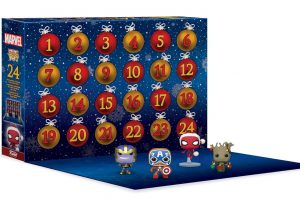
Now Advent calendars are conduits to Christmas containing everything from sweets to any number of prizes from our favorite franchises as evidenced here with a Funko variety.
‘Tis Better to Give…
Of all the Christmas traditions, maybe the biggest is gift giving.
Like all reciprocal obligations, there are rules. Christmas is no different with four to be exact.
The first, and probably the most fun, is Something They Want. Yeah, the category the includes toys and video games.
Next up is Something They Need. Not as much fun, but at least helpful.

…than receive
While this may fall under the above noted category, the third on our list is Something to Wear. It could be an article that’s needed like a coat or something whimsical like showy sneakers.
The final tic on our leader board is Something to Read. This can fall under the first category on our list, but it can also qualify for the second.
To help decide what to buy that special person, it never hurts to ask. It may also help those on a seasonal budget. A little suggestion of what to give also helps reduce some of the holiday stress.
However, one downside of asking questions is it leads to fewer surprises when correct assumptions are made about what’s under the wrapping paper. That doesn’t mean some aren’t above a little cheating. Some 10 to 20 percent of recipients admit to a little peeking prior to the big day.
Gift giving doesn’t have to be upsetting – unless you’re buying for someone like Jean Grey – so have fun.
Ho, ho, ho
Department store Santa’s used to be a dime a dozen. Now, they’re kind of a thing of the past. Like Santa’s who stood on street corners ringing bells asking for loose change for their charity of choice.
They still show for a special day or two at the mall. Kids still queue for a stop on his lap and a quick photo op. Santa stills ride herd on Christmas parades. Once designed to kick off the shopping season, these loiters along sidewalk streets are now more ornamental and traditional.
Yet there was a time when a visit to Santa Claus at the store was an event. He was the destination. It was your opportunity to get that wish list to the man responsible for making it come true.
And, all this started sometime about mid 19th century. Not in department stores, but candy shops.
Whatever the case, candy store owner James Parkinson is credited with hiring the first commercial Santa. His Philadelphia shop hosted the man in red for Christmas 1841. By 1846 three other Philly shops were sporting Santas.
As department stores began to pop up on the urban landscape in the 1860s and ‘70s, so did Claus clones.
As the new century dawned, so did a new tradition.
With store Santa’s became the norm during the holiday season, department stores began to up the ante. By 1920 Gimbel’s sponsored the first Christmas parade in Philadelphia.
Another followed in 1923, but the granddaddy of all holiday parades began in 1924 when Macy’s entered the field.
Post World War II and increased disposable incomes brought more and more shoppers to stores. To lure them in, department stores built larger and more elaborate displays even using real reindeer.
If these faux Kris Kringle’s ever return is not something we can answer now, hopefully they won’t be anything like Santa Joker here.
Plane, Trains and Automobiles
If you haven’t made your travel plans before this, now if the perfect time to catch up on our Advent calendar as today marks the first of the busiest travel days of the Christmas season and you may expect delays.
Tomorrow and the 22nd are the other two.
The after Christmas rush to get home is no picnic, either. Those days are the weekend following the holiday or Dec. 27 and 28.
It might not be a big surprise Christmas Eve and Christmas Day are much less congested days to travel. Fares are cheaper, too.
 A record 122.5-million people are expected to travel at least 50 miles this year for the holidays between Dec. 22 and Jan. 1.
The cost for all this transportation is projected to be $1.35 trillion.
Some are a bit more fortunate in that they can fly under their own power, i.e.Rogue, thus saving a bundle in money and time.
I’m Dreaming of a…
For as long as most of us can remember, the ideal has been for a white Christmas.
The classic concept may have began with Charles Dickens and his A Christmas Carol. The snowy backdrop set a tone for holidays to come for centuries.
Composer Irving Berlin tugged at patriotic and home sick heartstrings with his White Christmas recorded in 1940 just in time for the war.
Bing Crosby would lend his name and fame to the composition and concept with his rendition in 1941. The song would make its way to Hollywood for the movie Holiday Inn.
Crosby would further the myth with the self-titled White Christmas in 1954. The film co-starred the crooner’s comedic partner Bob Hope.

…White Christmas.
On a personal note, it wasn’t Christmas in our house when I was growing up unless my mother got to watch White Christmas on television. This was pre VHS, DVD/BluRay and streaming. You had to be in front of the cathode ray tube when one of the big three networks decided to air the film.
Life was a little easier for the mutants of Xavier’s mansion with Storm in residence.
Say Cheese
 The practice of photo Christmas cards dates back to at least 1891 when Annie Oakley (Google her if you don’t know) mailed a pic of herself from Scotland as holiday greetings.
However it wasn’t till the turn of the 20th century when the practice became a little more common. More economical, mass marketed Brownie cameras allowed middle class Americans to become photographers.
The 1960s marked a boom period for the practice of sending family-photo cards. These may have seen their heyday with the advent of social media and the ease in which photographs can now be sent.
Helping commemorate the tradition is Marvel’s resident shutterbug, er, shutter-arachnid, Spider-Man.
The Gift of Giving
Christmas gift giving is an amalgam of Saturnalia and the Magi and we couldn’t care less as long there’s at least one present under the tree with our name on it.
Former winter festivities featured much revelry and gift giving. Saturnalia would later be shanghaied and converted for religious purposes. Of course we’re talking about the ceremonies we currently call Christmas.
Many of the traditions designed to ward off the long, cold winter nights were also abducted and converted for the big day. One of those is offering presents. Mimicking the Three Wise Men and their presentations to the Christ child, gift giving was justified and became part of Christmas.
The practice was further enforced by fourth-century St. Nicholas who was a notorious gift giver to the needy. It wasn’t until the Victorian era when focus shifted to the children.
Industrialization and mass production encouraged commercialism and gift buying (and giving).
We probably don’t wanna know what Loki is offering, but even he seems to have the spirit of the season.
“Bah Humbub”
While we watch the calendar counting down the days to what many refer to as the biggest day of the year, consider Christmas was once illegal.
And, the institution that instituted the day outlawed it. Well, one faction at least.
In 1647, backed by a Puritan-backed Parliament, Christmas was outlawed. The Church of England did so citing the high holy day was pagan propaganda propagated by the Catholic Church.
Parliament would finally reinstate Christmas by 1660.
The decree would migrate to America in 1659 and last till 1681, mostly in Massachusetts.
Christmas would continue unfettered until 1969 when Cuba declared it illegal until 1998.
So, join Wolverine with a “Bah Humbub” in remembrance of a time when religious beliefs came before commercialism.
Can’t Catch Me…
I guess someone somewhere eats gingerbread. By and large it seems to be more of a decoration than delicacy.
Like fruitcakes.
We have those innovative Germans to thank for gingerbread’s origins. Monks would whip up spiced cakes for feasts. Later, Queen Elizabeth I would popularize the confection by commissioning it to be made in the likenesses of visiting dignitaries. But, it was German-born Prince Albert who brought the tradition of hanging gingerbread men from the Christmas tree.
With the rise of The Brothers Grimm’s fairy tale of Hansel and Gretel, so did the popularity of gingerbread houses and the practice of decorating them.
So, the practice of gingerbread men has endured throughout the centuries and continents. Enough so, we have a gingerbread Aquaman offered up in memory of the spiced treat.
Looney Tunes and Merrie Melodies Comics #136 (1953)
Tomorrow is more than a brand new day, it’s a brand new year.
Traditionally, today and tomorrow are the time to cast off any burdens that have held us back in the past. Today – or tomorrow – is the time for New Year’s resolutions.
To usher in 2026, Bugs Bunny plays protagonist to foils Elmer Fudd and Yosemite Sam. Both merely want to be less antagonistic during the coming year, but Bugs just wants to turn a buck.
Unlike the animated adventures, the enterprising bunny finds business can be bitter sweet.
Looney Tunes and Merrie Melodies Comics #136 (February 1953)
As for the business of the day, New Year’s resolutions originated with the Babylonians as far back as 4,000-years ago. However, their celebrations were held in March to coincide with the planting of new crops and the religious 12-day ceremony of Akitu.
In addition to pledging fealty to a new or reigning king, the Babylonians would make promises to their gods.
Continuing with a similar practice, the Romans offered sacrifices and pledged to do good deeds for their god Janus. Named for forward and backward looking pagan god, January became the first month of the year in 46 B.C. Romans would offer sacrifices and promises to do better in the coming year.
Christians adopted a similar habit. On the first day of the new year they would reflect on past mistakes with promises of better behavior.
An English clergyman and the founder of Methodism, John Wesley created the Covenant Renewal Service held on New Year’s Eve or Day. Events would include hymn singing and scripture reading. At one point, resolutions were made for the new year.
Today New Year’s resolutions are more of a tradition rather than a religious obligation. Data records, on average, about 45-percent of Americans make their promises, but a mere eight percent actually keep them.
Whatever you decide, happy New Year.