

International Clown Week: Clowning Around
Continuing with International Clown Week the Joker seeks revenge on the circus that turned him down.
In all the origins of the Joker, I don’t remember him ever attempting employment with a circus. Dick Grayson, yes. Jason Todd – pre Crisis – yes.
Even Geoff John’s premise never postulated a career under the big top.
Yet, here he is, taking revenge for a slight that may have never happened. To add insult to injury, the Joker’s plan is foiled by the ring master and common clowns working the three rings.
Though first introduced in Batman (1940) issue one, his origin wasn’t revealed until Detective Comics (1939) 168 in 1951. Alan Moore would expand and expound on that origin further in 1988’s prestige one shot The Killing Joke. John’s The Three Jokers is only the latest attempt to explain the Joker.
An interesting fact is DC Comics wouldn’t allow its stars to be seen chowing down on any of the Hostess goodies so as not to endorse the product.
Guess it was all right to shill for ‘em.


Clown Week: The Cornered Clown
So as not to be confused, there is such a thing as International Clown Day AND International Clown Week. We’ve celebrated before in 2020 with Obnoxio and Man-Thing.
For a little fun let’s go with International Clown Week. Plus, I’ve got a few Joker ads to toss in for good measure.
International Clown Day is celebrated the first day of August each year. It may be expanded by local government to encompass the whole week, as we’re observing.
Clown Week had its beginnings sometime in the mid 20th century. Walt Savage has been attributed with its creation. It wasn’t until 1966 Frank “Kelly the Clown” Kelly the president of the Clown Club of America, became the first International Clown Week chairman. American Clown Week chairman Bill “Boom Boom” Baily” lobbied Congress to recognize the event. President Richard M. Nixon declared the first recognized National Clown Week Oct. 8, 1970 as Public Law 91-443 as ratified by the 91st Congress. JJR 26 was passed by both the House and Senate. The joint resolution was signed into law by Nixon Aug. 2, 1971.
It wasn’t until 1988 it became an international happening. International Clown Week is observed from August 1 to August 7 each year.
Let’s celebrate with the Joker. He’s even brought the pie.


Batman Signet Book (1966)
The Beatles sang about ‘em. We’ve all read ‘em. Today we celebrate ’em. Today is Paperback Book Day.
Paperbacks have been around since the 19th century. Reduced manufacturing costs allow for a smaller price point and more affordability. This has made paperbacks popular since their introduction to a mass market. They also allowed publishers to offer books that normally wouldn’t be top sellers without fear of big losses.
Again, we’re not worried about marketing trends other than how they benefit our collecting habits.
Newspaper strips were the first to receive the paperback treatment. Reprints of favorites became spin rack fodder at drug stores and other non traditional outlets. Mad Magazine followed offering a huge library including both original material and reprints.
I looked and couldn’t find much information for Signet’s Batman  reprints. They are, really, the forerunners of the trade paperbacks that didn’t become popular until the late 1980s and early 1990s.
Signet’s first outing capitalized on the popularity of the 1966 Batman television show. Batman, the initial book, was released the same year as the TV series using Golden Age material to fill the interior. First up is/was a brief origin as originally told in Batman (1940) issue one. Next, The Batman Wars Against the Dirgible of Doom from Detective Comics (1939) 33, Web of Doom from Batman 90, Fan-Mail of Danger! from Batman 92, Crazy Crime Clown! from Batman 74, The Crime Predictor! from Batman 77, The Man Who Could Change Fingerprints! from Batman 82 and The Testing of Batman! from Batman 83.
Signet’s second outing was the novelization of three previous comic books: The State-Bird Crimes! From Batman (1940) 58, The Crime Parade from Detective Comics (1939) 124 and The Black Cat Crimes from Detective Comics 122.
For the third and fourth volumes, Signet returned to reprinting comic books. The third book featured Joker stories including The Challenge of the Joker from Batman (1940) 136, The Joker’s Winning Team (Batman 86), The Joker’s Millions (Detective Comics 180, The Joker’s Journal (Detective Comics 193) and Batman, Clown of Crime (Batman 85).
Penguin took top billing for book four with a Catwoman tale to finish the book. Stories included The Parasols of Plunder (Batman [1940] 90, The Golden Eggs (Batman 70), The Penguin’s Fabulous Fowls (Batman 76), The Return of the Penguin (Batman 155) and The Sleeping Beauties of Gotham City (Batman 84)
A fifth book was released adapting the 1966 Batman movie.
Other books would follow, Marvel with Lancer Publishing the same year. Both comic companies would continue to release paperback reprints through the 1970s and into the 1980s with Tempo, Pocket, Tor and others.
Each foray is a curious venture offering previously hard to find books to fans as well as tapping markets maybe untouched before.


Daredevil (1964) 8
If clothes make the man, then the villain makes the hero.
Sadly, until Frank Miller, Daredevil was at the mercy of whatever gimmicks or cast offs others had to toss his way. Electro was a mercy guest star in issue two, but not until DD 18 did the Man Without Fear finally meet the Gladiator.
Shoot, Doctor Doom didn’t even come slumming until the 37th issue.

Daredevil (1964) 8
No, Daredevil got to face off against the likes of The Fellowship of Fear, The Matador and The Organizer. Amongst that line up Stilt-Man made his first appearance in DD eight. He’s gonna be our emcee for a day tailor made for him if ever there was, National Walk on Stilts Day.
By now you know we don’t make these up. Yes, it is a real non-holiday inaugurated somewhere around the dawn of the new millennium by Bill “Stretch” Coleman of Denver, CO.
Bill is, and remember the definition of professional is someone who gets paid to to do it, a professional stilt walker. His reasoning for singling out a special day for the activity is to encourage others to take up the sport, hobby or career. His motto: “Walk tall and stretch your imagination!”
Stilts have been used for mobility since the sixth century BC. In the Landes region of France, shepherds would use them as aids with herding sheep. In urban areas they were a means to, literally, rise above the filth. Most recently they are employed more in business practices.
Kinda how Wilbur Day envisioned them. Only for more sinister purposes. Using stolen hydraulic ram schematics, Day created a telescopic legs and body armor for use in more larcenous endeavors.
Initially Stilt-Man and Daredevil were exclusive, but over the years Day branched out into the Marvel U and has fought such heroes as Iron Man, Thor and Spider-Man.
Day was the first Stilt-Man. He eventually met his end when the Punisher killed him during Civil War. He would later return during Dead No More: The Clone Conspiracy.
During the interim, an unnamed criminal happened upon the gimmick and fashioned himself as Stilt-Man. Daredevil, Luke Cage and Ms. Marvel all have had the honor of defeating this second incarnation.
A third player entered the field with the help of the Tinkerer. Michael Watts still has delusions of grandeur, but has been silent lately.
Outside comic books, the Day Stilt-Man appeared in the Iron Man episode The Armor Wars. Stilt-Man guested on the PSP version of Spider—Man: Web of Shadows and, finally, the Nintendo DS version of Iron Man 2.
So, stand tall, stand proud today. Try your luck at some stilt walking – if insurance premiums are paid up – or find some old Stilt-Man issues to read. I’m still on the fence about trying Daredevil eight. Guess I’ve done worse.


Showcase 77 (1956)
Slap a gorilla on the cover and the book will sell three times as many copies.
That was DC Comics Editor and Chief Julius Schwartz’s philosophy for the 1950s and 60s.
While it might seem insane today, it certainly seemed plausible at the time. Profits proved the fact as sales rose significantly when apes appeared on comic book covers.
Which may be how our hosts for the day got their start.
Angel and the Ape debuted in DC Showcase issue 77 in 1968, about the time comic books and apes were dissolving their unlikely and improbable relationship. The duo would star in seven self-titled issues before retiring to guest appearances and mini series.
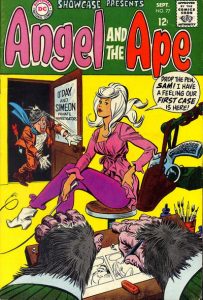
Showcase 77 (1956)
E. Nelson Bridwell and Bob Oksner were the creators. The premise was simple and 1960s. Considering Batman was camping it up twice a week on television with high ratings, a blond model and comic book artist gorilla moonlighting as private detectives weren’t beyond the realm of possibility.
Angel O’Day was the brains. Fluent in 12 languages, but still capable of kicking butt without chipping a nail. Sam Simeon was the brawn. His gorilla dialect often mistaken for unintelligible gibberish and hairy demeanor just part of the current style; both served to mask the real truth that Sam was an ape.
After disappearing for six years, DC printed a previously unreleased story in its Limited Collectors’ Edition C-34 Christmas With the Super-Heroes cover dated 1975.
We’ve already discussed this hidden treasure, but for continuity we’re adding it to their list of appearances.
Angel and Sam were thrown a bone here and there guest starring in other titles. It wasn’t until 1991 writer/artist Phil Foglio revived the pair in a four-issue mini series. Foglio expanded their existence in the DC universe making Sam the grandson of Flash rogue Gorilla Grodd. Angel’s pedigree proved her to be half sister to Inferior Five member Dumb Bunny.
Howard Chaykin and David Tischman chose to sex the two up in 2001 for another four-issue mini that just missed the mark all the way around.
A one-page story in the DC Holiday Special ‘09 wrapped up their time prior to The New 52. What remaining ‘60s charm they had left was completely stripped away leaving one running to eBay or back issue bins to wash the taste away.
What a sad way to close out a promising career.
As I stated when reviewing LCE C-34, Angel and the Ape have an allure born of the times they were created. Their short legacy is worth a visit; it won’t take long and may actually prove to be fun.
Oh, and today? It’s National and International Private Investigators Day. July 24 commemorates the birth year of Eugene Francois Cidocq, the first private investigator. His birthday is July 24, 1774 or 24/7 using the European method of placing the year before the day. There are an estimated 80,000 PI’s in the United States alone.


…one giant leap for mankind
Fifty six years ago today man proclaimed his independence from Mother Earth by stepping foot on a neighboring celestial body.
Today is Space Exploration Day, commemorating the 56th anniversary of man’s first walk on the moon.
For one day the inhabitants of this planet watched in unison as the culmination of centuries of dreaming and decades of work became reality.
Today, we will celebrate with a visitor from beyond and his creation to aid him in the betterment and protection of his adopted people. Today will be remembered with technology as fanciful and far fetched as the Apollo 11 rocket was not 50 years before its historic journey.
Our host is Superman and his contribution is the Supermobile.
You read that right, the Supermobile.
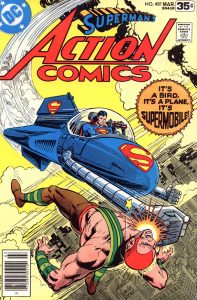
Action Comics
(1978) 481
Not even the Man of Steel, capable of leaping tall buildings and outracing speeding locomotives, is immune from commercialism.
Corgi Toys took advantage of its Superman license and the popularity of the 1978 Superman movie to manufacture a line of die cast vehicles. Thinking out side the box (office), Corgi asked DC Comics to create a vehicle for Superman to use in his endeavors. Writer Cary Bates concocted the Supermobile.
Debuting in Action Comics (1938) 481, the Supermobile was launched. The rocket is constructed of an invulnerable metal called, yes, Supermanium. Issue 481’s plot saw Superman powerless after exposure to red sun radiation. To battle Amazo, Superman crafted the Supermobile.
In addition to flight and invulnerability, the Supermobile channels Superman’s other abilities using large mechanical arms, his enhanced vision-related powers, super breath and super hearing.
No lie.
The Supermobile made limited appearances following its debut, but that didn’t stop Corgi from producing a 1/36 and 1/64 scale die cast model for store shelves.
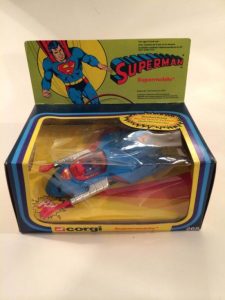
Corgi die cast Supermobile
When DC and Kenner toys launched the multi media Super Powers campaign in 1984 the Supermobile concept was dusted off again for the toy line. The design differed a bit with a few modifications to lower production costs.
McFarlane Toys resurrected the Super Powers line in 2022, but adhered to the original design this time.
So, when looking to the skies today, remember, “…one giant leap for mankind.” And, even Superman isn’t as powerful as the almighty dollar.
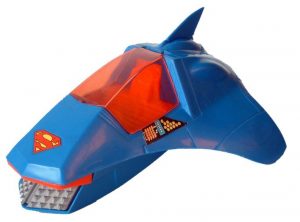
Kenner’s Super Powers Supermobile


Superman (1939) 393
We’re tapping Superman for a second time to emcee National Atomic Veterans Day.
Why?
Probably ‘cuz he’s about the only hero that can handle the fallout.
Literally.
The Man of Steel helped usher in the atomic age in Action Comics (1938) 101. By Superman (1939) 393 the Man of Tomorrow had become victim of the established era.
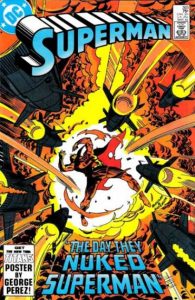
Superman (1939) 393
Overall, issue 393 is nothing to run out and pick up. The premise has The Master Jailer – anyone remember him? – seeking revenge on Clark Kent over his relationship with Lana Lang. To remove Clark from the picture, the Jailer realizes he must first deal with his protector, Superman.
Okay, here’s where today’s theme comes into play:
The Master Jailer launches nukes luring Superman out to stop them. When they explode, Superman finds himself a magnet for Kryptonite causing it to adhere to his skin.
Believing Superman to be out of the way, The Master Jailer next attacks Clark. However, he learns the Clark he encounters is really Superman in disguise.
Superman disables The Master Jailer, explaining how he duplicated the missile attack by creating Bizzaro missiles that reversed the magnetizing process.
While we usually recommend rereading a particular issue commemorating the day, forget Superman 393 and find a good book on the history and how the atomic bomb was created.
For a little background, July 16, marks the 80th anniversary of the detonation of the first atomic bomb at the Trinity test site.
Hundreds of thousands of soldiers participated in more than 200 nuclear weapons tests between 1945 and 1963. As many as 400,000 veterans qualify as atomic veterans according to the National Association of Atomic Veterans. Exposure to radiation in these cases has led to a wide array of health problems for these people including thyroid problems, tumors and deadly cancers.
Remember and respect both the day and those who were players and pawns during the time.


Rex, the Wonder Dog 4
We’re a little ahead of ourselves as I’ve been jumping around with postings. So, instead of offering you a history of primates on the covers of DC comic books, we’re gonna jump right in with World Chimpanzee Day. A history of apes and DC Comics will be forthcoming in about 10 days.
Sorry.
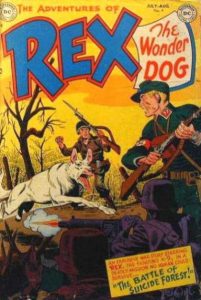
Rex, the Wonder Dog
Anyway, World Chimpanzee Day is a celebration established in 2018 through members of the Jane Goodall Institute. July 14 was chosen to commemorate the exact date Dr. Goodall first sat foot into the Gombe Stream National Park in Tanzania in 1960. Goodall dedicated 30 years of her life studying chimps and their culture.
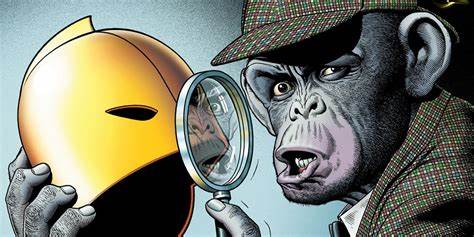
While we applaud the good doctor’s work, we’re gonna delve into stories involving one of the most intelligent of the species – though fiction – with Detective Chimp.
Originally dubbed Bobo the Detective Chimp by owner Fred Thorpe, the sleuthful simian is mainly known as just Detective Chimp these days. He was transplanted from the equatorial region of Africa by Thorpe in 1953. He was to be used as a sideshow attraction, answering predetermined questions via signals. However, Detective Chimp was given higher cognitive reasoning and the ability of speech when Rex, the Wonder Dog, showed him the Fountain of Youth in Florida.
His first appearance is in Rex the Wonder Dog issue four.
Detective Chimp became a detective for hire following the death of Thorpe.
Former Bobo assumed a more child-friendly appearance and demeanor as time passed. Detective Chimp would piggyback with other headliners and DC stars such as John Jones, the Martian Manhunter, a detective himself. The private eye primate was pulled out of retirement on different occasions to retain the copyright.
He was even granted a (very) small cameo on an episode of Teen Titans GO!


7-Eleven: Free Slurpee Day
I may have missed my annual post last year, but not my free Slurpee.
Again, if you’ve been following this site for any length of time, you know what July 11 means. This is one of the few days out of the year you can get something for nothing. Head on over to the local 7-Eleven or one of its subsidiaries: A-Plus, Speedway or Stripes Convenience Stores and have ‘em set ya up with a carbonated slushy.
Omar Knedlik is the father of the frozen beverages. When his soda fountain broke, Knedlik was forced to store his pops in a freezer to keep them cool. Extended exposure to the extra cool temperatures caused the pop to congeal. Customers found the semi frozen drink refreshing and a legend was born.
This year’s link between Slurpees and comic books comes from a long mistaken belief I had.
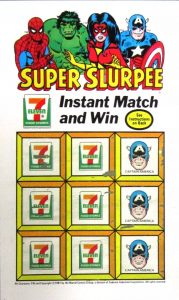
Scratch ticket
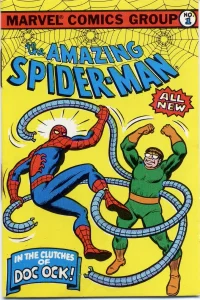
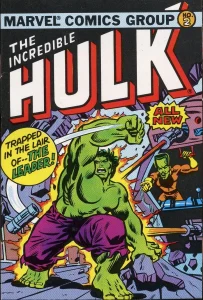
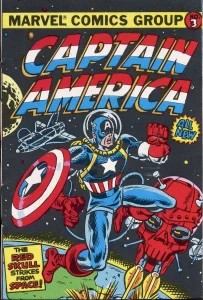
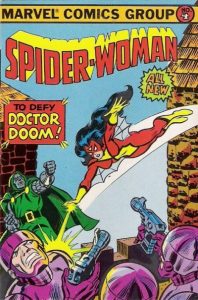
Way back in 1981, 7-Eleven and Marvel ran a contest. The convenience store offered a scratch-and-win game. Buy a Slurpee and get a ticket. Match three-in-a-row and you received a prize.
For the longest time I thought the prize was one of four mini comics. Each were two and five-eighths by three and a half inches, 10 pages in length, with a stick of gum. The first was Spider-Man in The Clutches of Doc Ock!
Next was The Hulk in Trapped in the Lair of The Leader!
Issue three featured Captain America in Satellite of the Red Skull with Spider-Woman in To Defy Doctor Doom! rounding out the line up.
One day I happened across The Secret of the Power Crown, a full-size, original Marvel comic book featuring the above four heroes. A little research and I find that what I’ve believed to be promotional mini comics are in reality Amurol’s Bubble Funnies.
The Bubble Funnies were offered in a box much like trading cards to the public at large. In addition, mini Archie and Sabrina the Teenage Witch comic books were sold along with the Marvel books.
I never saw The Secret of the Power Crown at that time.
I still have my Bubble Funnies, even after all these years. They are no less treasured. They can be found on the secondary market fairly easily and are nice – if odd – additions to any collection.
For me, they will still be my rewards for playing the scratchers and niche pieces in my collection.


International Clown Week: Laugh, Clown, Laugh
Art theft closes out International Clown Week.
The Joker attempts to divert attention from his painting pilfering by tossing pies at the police.
Spoiler alert: it doesn’t work.
While Laugh, Clown, Laugh is a fictional piece of art the Joker attempts to steal, there are many famous clown paintings.
Master of modern art Pablo Picasso crafted Harlequin Head, a piece stolen in 2012 as part of the heist of the century. Stolen from the Kunsthal Museum, the Picasso piece was the most famous of the seven works still missing. The thieves were apprehended, but the Harlequin is feared to have been destroyed.
The master is also known for his The Blue Clown. Appropriately enough, it is symbolic of Picasso’s Blue Period.
Other well known artists noted for their work regarding the joyful jesters include Antoine Watteau, Claude Gillot, Francisco Goya, Honore Daumier, Gustavo Courbet, George’s Seurat, James Ensor, Henri de Toulouse-Lautrec, Andre Derain, Vino Severini, Max Beckmann, Pa Hooper and Walt Kuhn.
Maybe the most notorious was John Wayne Gacy. His penchant for portraying a clown – Pogo – prior to his arrest may have led to his choice of subjects while painting on death row.
Convicted of murdering 33 adolescent males, the infamous serial killer used a portion of his 14 years behind bars creating over 2,000 paintings.
His somewhat self portrait, Pogo the Clown, sold for $12,800 Oct. 31, 2022.
Gacy received his lethal injection May 10, 1994.