

Sensation Comics (1942) 38
Wonder Woman opens Sensation Comics issue 38 with a Noel novella not to be found in any Christmas collection.
Creator William Moulton Marston describes the yule-time action that follows in the opening blurb:
“Using her Amazon airplane instead of reindeer, Wonder Woman plays Santa Claus for poor children, filling their empty stockings with presents and their longing hearts with love for the world’s most beautiful girl!

Sensation Comics (1942) 38
“But the lovely Amazon Princess lands in plenty to excitement and danger too, when she leaps from Miss Santa Claus’ sky charger into a hidden nest of vicious gold vault robbers. To save her two young friends, Pete and Gertie, Wonder Woman is compelled to surrender herself captive to these ruthless plunderers!
None but the maid from Paradise Isle, beautiful as Aphrodite, wise as Athena, stronger than Hercules and swifter than Mercury, could possibly escape the dangers and ordeals which confront Wonder Woman when ‘Racketeers Kidnap Miss Santa Claus’.”
Amid pleas for war bonds and ads for cereal the book is rounded out with “The Story of Sir Francis Drake,” Little Boy Blue and the Blue Boys in “Treasure for 10 cents,” “Vandals Desecrate Churches” with The Gay Ghost in an untitled short and Wildcat in “Meet Mr. Waffles.”
Also tossed in to meet requirements for a cheaper mailing rate is the two-page text tale “Double Cross.”


Scooby-Doo (1997) 127
No holiday story, just a colorful Christmas cover for this indicia-dated February 2008 issue.
Included are three stories. “Family Monster” is the first. Velma drags the gang to Germany for the reading of a will at Castle Von Dinkley. The kids help a Frankenstein monster clone keep his home. Script by Greg Thompson and pencils by Jaime Garcia Corral.
“Football Fiend” follows with the gang foiling plans to sabotage a new stadium. Robbie Nely and Dan Davis do the honors.
The “Freeloading Ghost” finds himself homeless with plans to avenge his eviction. Scooby-Doo shows some unaccustomed bravado when the specter over-steps his bounds. All courtesy of Darryl Taylor Kravitz and Karen Matchette.


Santa Claus Conquers the Martians (1966)
Dell produced the comic book adaptation of the movie in March, 1966. To add insult to injury, a Comic Book Storyteller edition was offered with a read-along record voiced by Dan Ocok, Ann Delugg and Ralph Bell. The album also featured the film’s theme song, “Hooray for Santa Claus.”

Santa Claus Conquers the Martians (1966)
Often billed as one of the worst films of all time, Santa Claus Conquers the Martians appeared in theaters in 1964. The film was based on a story by Glenville Mareth and was directed by Nicholas Webster.
The plot is pretty much spelled out in the title. When Mars children are found to be living by too rigid standards, Santa Claus is kidnapped to bring some whimsy to their world. Saboteurs attempt to foil the plan, but are set straight by the man in red. Santa is released from his captivity and returned to Earth in time to make his Christmas Eve rounds.
The film has become a cult favorite in part to its public domain status. During its initial release the film did recoup its production costs as well as making a profit.


The Mighty Marvel holiday Wish List (1990)
Comic book shops were common place by the beginning of the 1990s, but original graphic novels and trade paperbacks were not.
The Might Marvel holiday Wish List, sporting a caroling Spidey, Hulk and Cap, was a festive gift guide for the comic book fan. What could be simpler? Make a check beside the corresponding title, hand it to the gift giver and wait for Christmas morning.
Looking back at this pre-internet solicitation reminds me of how far the industry has come. Of course I forget this is 30 years ago.

The Mighty Marvel holiday Wish List (1990)
The year 1990 doesn’t seem that long ago. Saying 30 years does.
Anyway, 30-years ago trades and collections were not the norm. Marvel had its high-end Masterworks and DC its Archive editions. Those were available in most comic book shops and retail book chains. They were just pricey for the day.
Trades were much more reasonable, but still a novelty. That’s why it’s so odd looking at the ad paper and seeing so few story arcs collected.
Readers must also remember this was a time when stories were written from beginning to end with no worries about how they would fit in a trade.
As much as I love Neil Gaiman and Sandman, I blame the wordsmith for the advent of trade-length story arcs. He invented the four- to six-issue story arc with a few one-and-dones in between that seem to have become the industry standard for trades.
So, sit back and check out the Mighty Marvel holiday Wish List – in full – courtesy ComicBookDaily.com. It’s a nostalgic look at the not-so-distant past.


Marvel Holiday Special (2005)
Marvel recycled the cover and stories for its Marvel Holiday Special trade, but the original 2005 one-shot was all original.

Marvel Holiday Special (2005)
Shaenon K. Garrity serves up a jaunty pre-Christmas tale with shades of Citizen Kane. The Fantastic Four and Namor celebrate the holiday to satisfy an aggrieved Moleman’s childhood fancy in “Moleman’s Christmas.”
The disgruntled youth’s misgiving-theme is continued in “Yes, Virginia, There is a Santatron.” Spider-Man swings in late for the annual Avenger’s Christmas party. An unexpected – and unwanted – guest arrives in a Tannenbaum trimmed Trojan horse. Heroes prove their mettle as they circumvent the intrusion with a confederate confection.
Marvel’s holiday season comes to a close with “Christmas Day in Manhattan.” A rhythmic recital has the Fantastic Four saving another holiday from a poor-intentioned father. Their mercy provides presents for the innocents.
This 2005 edition is a worthy addition to any collector’s repository. A goodly portion of the Marvel U appears in either leading rolls or in cameos. The stories are heartwarming without being saccharine and the feeling of the season is almost tangible.


Harley Quinn and the Suicide Squad April Fools’ Special (2016) 1
This one is a real stretch. Beyond the title, there’s no real April Fools shenanigans. What the issue does is act as a launch pad for Rob Williams’ Suicide Squad series to follow.
Jim Lee bookends the title with his artwork while Sean “Cheeks” Galloway takes care of the dream sequence pages. Williams sets the stage with his script.
-
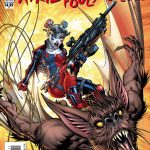
- Harley Quinn and the Suicide Squad April Fools’ Special (2016) 1
-
- Harley Quinn and the Suicide Squad April Fools’ Special (2016) 1 (Blank Variant)
-
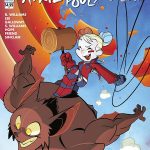
- Harley Quinn and the Suicide Squad April Fools’ Special (2016) 1 (Sean Galloway Variant)
-
- Harley Quinn and the Suicide Squad April Fools’ Special (2016) 1 (Jim Lee Sketch Variant)
-
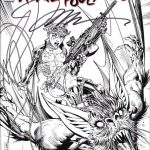
- Harley Quinn and the Suicide Squad April Fools’ Special (2016) 1 (Inks Retailer Variant)
The book is mainly Harley acting as her own Ying and Yang. Psychoanalyzing herself, Harley finds she is drawn to good – as long as she can still indulge her naughty tendencies. Her dream serves as a sounding board to her struggle between light and dark.
The book itself is designed to complement the upcoming Suicide Squad movie and comic book. Neither seemed to fare well.


Happy! (2012)
Grant Morrison drops enough F-bombs to level a mid-size city in this four-part Tanenbaum version of Taken.
Not for the faint of heart, Happy! is pretty much anything but. Quick to make the anxious blush, Happy! offers little on the way to redemption. Not until Nick Sax learns his past is in front of him. All he has to do is save it.
Happy is the means to that end. And, the imaginary guide leading the migration through a heart attack, his past and four issues. The strong language crafts a foundation that has no redeeming qualities.
Nor does Sax’s life. Not from the onset of an affair that has him cheating on his wife and the police force he serves. His fall from grace leads to merry-go-round of drugs and alcohol.
Taken in one sitting, the story moves like a Quentin Tarantino vehicle with Bruce Willis at the helm.
Don’t pick this up for the kiddies, but enjoy a guilty pleasure that – hopefully – won’t put you on the naughty list.
-
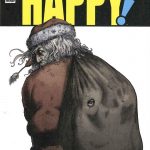
- Happy! (2012)
-
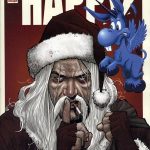
- Happy! (2012) variant cover
-
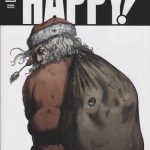
- Happy! (2012) second printing


Tim Burton’s The Nightmare Before Christmas Halloween ComicFest (2016)
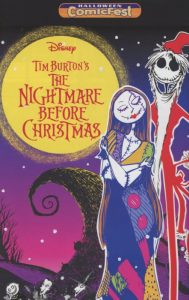
Tim Burton’s The Nightmare Before Christmas Halloween ComicFest (2016)
Tokyopop reprinted a portion of the 2005 original graphic novel of the same name to celebrate Halloween ComicFest in 2016.
This is not a direct interpretation of the movie. Instead the graphic novel is based on the original poem Tim Burton presented to Disney while he worked as an animator there in the late 1970s and early 1980s. The illustrations are his as well.
Those only familiar with the movie may be disappointed due to the absence of some characters including Oogie Boogie who were later included in the movie. The illustrated novel further skips over the Halloween aspect and focuses solely on Christmas.
A Nightmare Before Christmas was released Oct. 29, 1993. The film grossed over $76 million in its initial run. Henry Selick directed the feature as Burton was busy with development of Batman Returns.


Bugs Bunny’s Christmas Funnies (1950) 5
Bugs and friends starred in the self-titled Bugs Bunny’s Christmas Funnies from 1950 to 1958 under the Dell imprint.
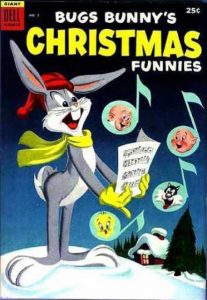
Bugs Bunny’s Christmas Funnies (1950) 5
The fifth installment includes:
- Bugs saving Christmas from the Old Man of the Mountain;
- Porky Pig finding the error of his ways in the Bizzaro world of Backward’s Valley;
- Tweety and Sylvester tearing a department store apart as the hungry cat tries to fulfill the flighty bird’s wishes;
- Elmer and Daffy squaring off with explosive results as a parade loses its float;
- Bugs and Elmer headlining in a one-page gag;
- Petuna Pig with piggy bank woes that Pork cannot fix;
- Little used Henery Hawk making an appearance and earning a shiner;
- Mary Jane and Sniffles forming an unusual bond to locate their run away gifts;
- Porky and Petuna returning for a mashed up, mix up; and
- Bugs isn’t the only one to suffer when his pretending becomes pretentious.
All in 100 pages for a quarter.
While a bargain today, a quarter in 1955 is currently the equivalent of $4.70. Of course a regular comic book runs four dollars. Maybe it’s still a bargain.


The Unexpected (1968) 202
Host Abel welcomes readers to the House of Secrets library.
The Unexpected (1968) 202
“Hopping Down the Bunny Trail” has no Peter Cottontail in this cautionary Easter story. Rather, the youth are held accountable for their treatment of confectionary bunnies over the years. Michael Uslan and Tenny Henson serve up this unsavory tale, darkening the pastel holiday.
Carl Wessler and Torre Repiso take the lead in “Death Trap,” the actual first story of the book. An escapee from the local asylum terrorizes the wrong person.
Following DC’s implosion in 1978, the three witches from The Witching Hour found residence with fellow refuge Abel. They take a turn at two tales, “The Midnight Messenger!” and “The Creature in the Park.”
In the first, a believed deal with the devil proves to be more celestial. By their second and final story nature turns the tables on (in)humanity.