

Wonder Woman (1942) 212
First, thanks to Dave’s Comic Heroes Blog. He birthed the correlation between Wonder Woman’s 12 Labors and Labor Day.
Taking the cue we’re gonna delve a little deeper into those chores as we lead up to the last hurrah of summer, Labor Day.
The 12 labors were introduced to Hercules as atonement for slaying his wife, son and daughter. Diana’s (Prince) penance was every bit as voluntary, but committed to prove to herself she is worthy to rejoin the Justice League of America.
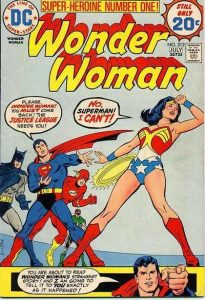
Wonder Woman (1942) 212
To back up a little, DC, still National Periodicals, was attempting to update their characters. Denny O’Neil and Neal Adams had already revamped Batman, Green Lantern and Green Arrow.
Wonder Woman creators removed her powers. She was given a boutique and sensei named I Ching. He would train her to become a martial arts expert to compensate for the loss of her natural abilities.
The backlash was tremendous. Diana was allowed to return to her Amazonian princess status and regain her powers. Her rebirth was not without pain as creators attempted to reintroduce the heroine with her powers.
It was decided she had memory loss at the time she suffered her power loss. In addition, to prove to herself she was worthy to return to the Justice League fold she would have to perform 12 tasks. During each Wonder Woman would be monitored by a member of the League to determine if she passed.
Issue 212 was her return to William Moulton Marston’s original incarnation. As explained above, Wonder Woman discovered she had suffered memory loss and set about the first of her contests.
Superman was her observer narrating the story after the fact. In his eyes she passed her first test.


Punisher Holiday Special (1993) 1
Steven Grant and Eric Fein take the Punisher down two very, un-Merry Christmas trails.
“Red Christmas” is the quest to bring Little Tony Caruso what he wants for Christmas. What he wants is the Punisher’s head in return for the death of his father.
Pleasant Valley Mall becomes the battleground.
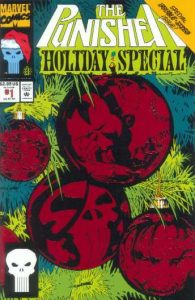
Punisher Holiday Special (1993) 1
It’s interesting to turn the clock back. Look at the backdrop with the drapings of 1993. At this writing, that was about 25 years ago. A time when compact discs still housed our music. Cordless telephones were high tech. Malls were still in vogue.
Maybe the best of the flashbacks was Stan’s Soapbox. Even after several months it’s hard to believe the man who raised so many of us has passed. It’s nice to know he’ll never be completely gone.
No seasonal glad tidings from The Man. No, Stan was at his best when huckstering. He was laying it on with a shovel in this issue. Marvel had conquered the United Kingdom and Stan wanted the Marvel Zombies in the colonies to know they could have a piece – for a nominal fee of course.
Rounding out the book, the body count drops in “Armed Salvation.” The Punisher teaches a little boy family is the more important than any petty grievances.


Amazing Spider-Man (1963) 194
Believe it or not, there is a National Black Cat Appreciation Day. And, that day is today.
What better comic book to represent our ebon feline friend than Amazing Spider-Man (1963) 194, the first appearance of Felicia Hardy, aka the Black Cat.
The beauteous Black Cat originated from a textbook-Freud/Jung Father Complex. Felicia’s father was a notorious cat burglar. To earn his love and respect, she emulated her father and later tried to break him out of prison.
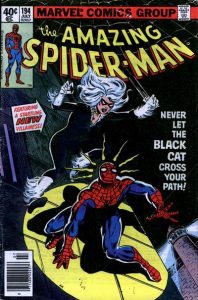
Amazing Spider-Man (1963) 194
Her original appearance ended in the second issue of a two-part story arc as she fell, seemingly, to her death.
Felicia would return a year later in Amazing Spider-Man (1963) 204 for another two-part story line. This time her affections would be focused on Spider-Man.
Eventually a romance did bloom. Felicia repented of her criminal ways and became Spider-Man’s lover. I say Spider-Man, because the thought of Peter Parker and his mundane life outside the costume repulsed her.
She would go on to secure “powers” from the Kingpin allowing her to induce black cat hoodoo against anyone wishing to do her harm.
Eventually Spider-Man and Black Cat would go their separate ways.
Felicia has had a healthy career in the Marvel Universe as a sexy siren. In addition to appearing in various Marvel mags throughout the years, Felicia has starred and co-starred in mini-series sporting her name and image.
To properly observe the day, National Day Calendar suggests consideration of adopting a black cat.
Four Color Holidays suggests you curl up with several favorite issues featuring the felonious feline with your favorite real life feline.


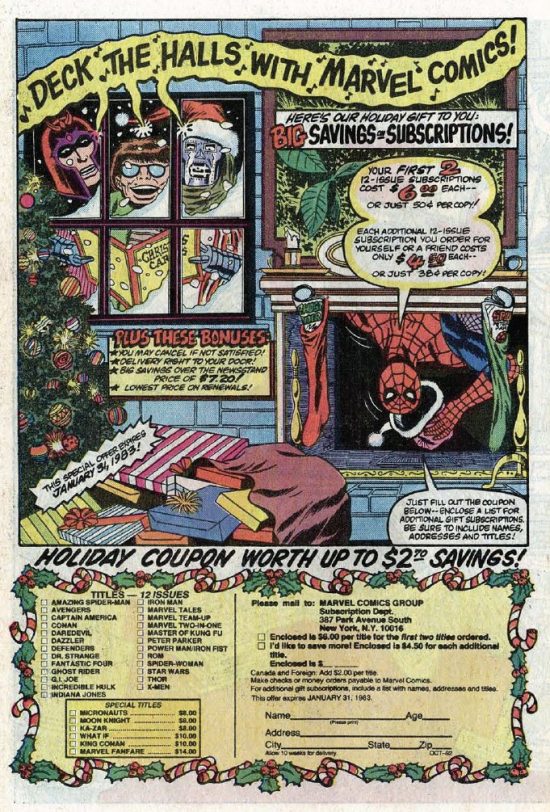
“Deck the Halls with Marvel Comics”
Before Black Friday was a thing, Marvel Comics Company tried to help the holiday shopper with this house ad for the perfect gift.
Apparently the thought of not having to fight holiday shoppers for the gifts is enough to set Magneto, Doc Ock and Dr. Doom caroling.
In addition to staying home, shoppers have the knowledge they may cancel their subscription at any time if not satisfied, orders are delivered right to their door, they will save a whopping $7.20 off newsstand prices and are offered the lowest price on renewals.
Santa Spidey continues to plug the ad by exhorting, “Your first two 12-issue subscriptions cost $6 each—or just $.50 per copy!
“Each additional 12-issue subscription you order for yourself or a friend costs only $4.50 each—or just $.38 per copy!”
This was a time when Marvel offered just 25-regular titles. Special titles included the Micronauts, Moon Knight, Ka-Zar, What If…?, King Conan and Marvel Fanfare.
Too bad the ad expired Jan. 31, 1983 considering what comic books cost today.
According to Wikipedia, Black Friday didn’t receive its name until recently even though the day after Thanksgiving has been considered the kick off for Christmas shopping since 1952.


Sandman (1989) 18
Today is International Cat Day, or World Cat Day if you prefer. Not to be confused with National Black Cat Day and National Cat Day observed Oct. 27 and Oct. 29 respectively.
It is a day to celebrate our feline friend. The sneaky and snarky pet that pads through our lives – usually after dark – and enriches all it touches.

Sandman (1989) 18
Neil Gaiman represented the notion of the superior Felis silvestris in issue 18 of Sandman. A tale of lost majesty; our furry friends suffer in silence.
Having just finished “The Doll’s House” story arc, Gaiman used issues 17 through 20 as a resting point for himself and readers. The author followed “Doll’s House” with the seven-chapter “Season of Mist” tale.
“A Dream of a Thousand Cats” proved a whimsical prior to another novella. Cats are told a story of how they became subservient to man. It is the belief if 1,000 cats can dream their lives as they existed prior to their downfall, all would return to normal.
Though having enthralled her listeners, the cats disband knowing it will never happen. As stated, getting 1,000 cats to do what they are told is impossible.
International Cat Day was first observed in 2002. It is to celebrate the kinship between feline and human. Additionally it is to promote the safety and well-being of cats.
To observe International Cat Day, celebrants are encouraged to volunteer at a local cat shelter, visit a cat café, donate to a cat charity or just enjoy their fuzzy friends. The holiday is celebrated every Aug. 8.


Amazing Fantasy (1962) 15
Based on today’s headline, any comic fan should be able to guess this is National Spider-Man Day.
Created by Stan Lee and Steve Ditko, Spider-Man first appeared in Amazing Fantasy issue 15. Other stories included were “The Bell Ringer!,” “Man in the Mummy Case!” and “There are Martians Among Us!”
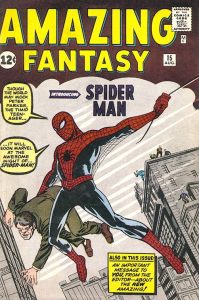
Amazing Fantasy (1962) 15
When sales figures returned for what was the final issue of the title, Spider-Man proved a financial success. He returned in his own book, The Amazing Spider-Man in March of 1963. Lee and Ditko continued to chronicle his exploits to issue 38 when Ditko left. Lee remained scripter until issue 100.
Though the Fantastic Four were recruited to help bolster sales for the first issue, it quickly became apparent the guest stars were not needed. In little time Spider-Man became the flagship of the Marvel Universe.
By mid-decade Spider-Man was as recognizable and popular as Bob Dylan. In 1972 he received a second series, Marvel Team-Up. As the title may indicate, Spider-Man would join other heroes for one-and-dones or story arcs.
In 1976 a third book was devoted to the character, Peter Parker, the Spectacular Spider-Man. This one dealt more into the Web Head’s alter ego.
In 1985 Marvel Team-Up ceased publication. Web of Spider-Man replaced it, focused solely on Spider-Man.
Since then titles have popped up or ceased publication, but always sold well.
Spider-Man first appeared on television during Saturday mornings. Spider-Man ’67, as it’s become known, ran from 1967-70. Spidey shared television time with himself in the early 1980s when Spider-Man and Spider-Man and his Amazing Friends ran concurrently. Fox Kids studios would option a series in the 1990s running five seasons and 65 episodes. Spider-Man Unlimited followed.
A CGI series aired following the Spider-Man movie. Not until 2008 would he return in animated form. This time in The Spectacular Spider-Man beginning March 8. Ultimate Spider-Man followed on Disney XD in 2012.
The character’s two lone forays into live action on television were the Electric Company shorts and syndicated The Amazing Spider-Man starring Nicholas Hammond.
A Japanese version aired in 1978.
Spider-Man broke into Hollywood with a feature film in 2002. That was followed by two more before the franchise was rebooted in 2012. Spider-Man Homecoming, released in 2017, was a second retooling of the character on the silver screen. Most recently was Spider-Man: Far From Home.
In addition to the small and big screen appearances, Spider-Man has been featured in pretty much every medium there is to offer. His comic books continue to sell and his likeness is one of the best recognized in the world.


Captain Marvel (2014) 11
Captain Marvel has one day on Earth. Good thing it’s for the holidays so she can save Santa Claus and Christmas.
Maybe.

Captain Marvel (2014) 11
Depends on how you read the story.
Carol Danvers does return to Earth for 24 hours. During that time she visits a dear friend and mentor in the hospital. At least until she’s abducted, restrained and held with Santa Claus.
Here’s where it gets fuzzy. Not sure if it’s Christmas magic that turns a down-and-out Mr. Kringle into the real thing or not. All that’s certain is he’s trussed up like Marsellus Wallace in Pulp Fiction. And, the gimp is coming.
All is well by book’s end and Captain Marvel is ready to return to her duties.
The issue is called “A Christmas Carol Part Two of Two,” but part one is just a vehicle to get Carol back home for the holidays.
It’s probably better if you’re a regular reader of the title. There’s enough history to keep someone like me clicking to Wikipedia for some background. Still, a nice Christmas tale.


Jingle Belle: The Fight Before Christmas
This 2005 one-shot is made up of three acts: the title, “Hot Rod Lemming” and “Oh, Christmas Tree.”
In “The Fight Before Christmas” Jingle heads up the North Pole Elves against long-time Bi-Polar Hockey League rivals Tibetan Snow Leopards. Jingle’s rivalry is with Tashi Ounce, team captain of the Leopards.

Jingle Belle: The Fight Before Christmas
The two spend more time in the penalty box making small talk than on the ice scoring. That all ends when two-timing boyfriend Brad is found to be making time with a third opponent.
In the second story, Jingle gives Len the Lemming advice only to learn it doesn’t work both ways in “Hot Rod Lemming.”
Finally, creator Paul Dini serves up a none-to-flattering commentary on the second Bush Administration.
Belle is the spoiled teenage daughter of Santa Claus. She was created by Dini in 1999. Since then her appearances have been sporadic at best. Jingle has been corralled in five collected editions: Jingle Belle: Naughty and Nice, Jingle Belle’s Cool Yule, Jingle Belle: Dash Away All, Jingle Belle and Jingle Belle: The Whole Package.


Werewolf by Night (1972) 32
In honor of National Moon Day, today, Four Color Holidays looks at Moon Knight.
Moon Knight first appeared in Werewolf by Night 32, August 1975. He returned in issue 33, then was granted a two-issue solo series in Marvel Spotlight issues 28 and 29. Ironically enough, Marvel Spotlight is where Werewolf by Night got his start.

Werewolf by Night (1972) 32
After a two-year layoff, Moon Knight returned as a guest in Peter Parker, the Spectacular Spider-Man (1976) issues 22 and 23. From there, Moon Knight bounced around appearing in Marvel Two-in-One issue 52. Later he would join the Defenders in issues 47-51.
His final outing before earning his own title came as back up stories in Hulk! (1978) issues 11-15, 17-18 and 20 and Marvel Preview (1975) 21.
Moon Knight received his own series in 1980 under the guidance of Doug Moench and Bill Sienkiewicz. It would last 38 issues and be followed by the Moon Knight – Fist of Khonshu six-issue mini-series in 1985.
The journeyman character would roam the Marvel U until 1989 when he received his second ongoing series, Marc Spector: Moon Knight. This lasted through 60 issues ending in 1994.
Moon Knight would appear in one-shots and minis over the next 10 years. Not until 2006 would he receive another ongoing title. He would appear off-and-on throughout the remainder of the former decade and this in his own titles finally settling back with the Marvel Legacy numbering system reaching issue 200.
The Moon Knight character is as complicated as his publishing history. First introduced as a mercenary, he would embrace the label. Marc Spector became that personality. After his baptism by violence and moon light, Spector became a hero branching off into Steven Grant, the millionaire playboy who financed Moon Knight’s adventures and Jake Lockley, the cab driving everyman who earned the respect of the common people.
Those split personalities would manifest themselves over the years and become a point of contention with Moon Knight and those involved in his world.
To date, he is one of the few Marvel characters that has not been earmarked for a multi-media offshoot. His personality disorders and moon worship have often been cited as the cause.
National Moon Day is observed annually on June 20 to commemorate the first moon landing in 1969. Neil Armstrong and Buzz Aldrin became the first two men to set foot on the moon.
In 1971, President Richard M. Nixon proclaimed National Moon Landing Day on July 20. Richard Christmas rallied to continue the day when no official proclamation followed. Through a letter-writing campaign Christmas persevered and June 20 is recognized by most states in the union.


Wonder Woman (1942) 213
Continuing the tale of Wonder Woman and her 12 labors, the second was observed by Flash. The Amazon princess was at odds with a robot bent on spreading peace.
Wonder Woman (1942) 213
As America attempted to extricate itself from Viet Nam in the early 1970s and politicians like Henry Kissinger became celebrities, mediums like television, movies and, yes, even comic books took notice.
DC wasn’t the only comic book company to parlay the events of the day into fantasy fodder. Marvel’s Super-Villain Team-Up used the name and likeness of Kissinger. Captain America became a man with no country as Nomad when he turned his back on the United States following Watergate.
At National, pre-DC days, Kissinger became Hans Krissen and even courted Diana Prince.
The issue revolved around the notion Earth had succumb to pacifism. Inhabitants can no longer defend themselves against ordinary dangers. Wonder Woman discovers she and two others are immune and must challenge the cause.
Of course they succeed and the world is allowed to return to its barbaric ways. The Flash, who has been observing Wonder Woman’s trial, reported she proved extraordinary in her efforts. She is therefore recommended for reinstatement to the Justice League.
Enjoy the countdown to Labor Day with Wonder Woman’s 12 labors with more tomorrow.