

The Simpsons’ Treehouse of Horror (2012) 18
If Sam Rami’s original Evil Dead is a low-rent version of Hollywood horror, then Shane Houghton’s Evil Beery is just low rent.
Evil Beery is the first of four tales designed to terrify for 2012. Shane Houghton is the mastermind; Chris Houghton is the visionary and Josh Ulrich the color man.
The story offers a chilling origin of Duff’s Beer. In addition to the Evil Dead, the Houghton’s bring a blend of Cabin in the Woods to the table.
Margemary’s Baby is a two-tone treatment of Rosemary’s Baby.

The Simpsons’ Treehouse of Horror (2012) 18
Based on Ira Levin’s disturbing 1967 horror novel, now disgraced director Roman Polanski told the tale to an eager viewing public a year later.
The current classic had praise heaped upon it from opening day. Ruth Gordon earned an Oscar and Golden Globe for Best Supporting Actress.
It spawned a mini-series in 2014.
One Bart and Stormy Night is the titular character’s nightmare come true. A super-hero/monster motif has the whole family unwittingly participating.
Jim Valentino’s The Bride is a warmed-over recollection of storytellers who all have a different view of the movie of the same name.
The book caps off another Halloween staple with Bongo Bonus Stamp number 211 featuring Hugo.
For those who remember the Marvel Value Stamps, this nod to their marketing campaign that saddened many of today’s collectors is just fun. Warning: don’t cut it out.
More why in December.


The Simpsons’ Treehouse of Horror (2011) 17
A loving homage to the Universal staples of the golden age of horror on the cover open the perennial four-color Treehouse of Horrors.
Zander Cannon and Gene Ha craft Nosferatu a Simpsony of Horror to begin the begin.

The Simpsons’ Treehouse of Horror (2011) 17
The 1922 German vampire tale is retold as a choppy, organ-orchestrated story driven by dialog cards and expressionist art. Like many parodies, it does a tightrope walk between its inspiration and its destination.
Bart is coerced to sell his treehouse to help the family financially. He learns the truth under the hospitality of Mr. Burns, aka Nosferatu, but it’s his mother who saves the day in the final panels.
Nosferatu was a thinly disguised Dracula retelling that was eventually found out and the lineage of Braham Stoker reimbursed. All copies of Nosferatu were ordered to be destroyed, but at least one print survived. It became a blueprint for horror films to come.
Marge of the Dead takes a stab at the zombie craze. Jane Wiedlin and Tom Hodges pen and pencil the story with colors from Mark Hamill’s real life padawan, Nathan.
The Simpson family participate in a seemingly harmless cosplay event only to stumble onto the city-wide outbreak of zombies. Lisa’s big-brained overthinking brings the story to a happy close.
Finally, EC Comics receives a love letter as Bart delves into issue three of Harvest of Fear.
Both story and comic book title, Harvest of Fear is an admitted knock off of Bill Gaines’ comics from the 1950s.
Originally called Educational Comics, EC became Entertaining Comics after the death of founder Max Gaines. Son, William, reluctantly took the wheel and steered the floundering company out of debt with an unrivaled team of writers and artists.
Together the cadre crafted a series of comic books with horror, crime and science fiction themes that are lauded even today. Their success was not to go unnoticed and EC Comics became part of a larger investigation into the field of comic books. In the end, the witch hunt neutered the industry, leaving EC’s stable of titles as dead as so many of their stories heroes.
The one positive that did rise from the government raid was Mad Magazine. William Gaines had already begun publishing of the title, but moved it to a magazine format to keep it safe from the newly minted Comics Code Authority.


The Simpsons’ Treehouse of Horror (2010) 16
Another Halloween, another Treehouse of Horror.
The 2010 team included, Evan Dorkin, Peter Kuper, Kelley Jones, Kelvin Mao, Tom Peyer, and Tone Rodriguez. Special assist from Lemmy Kilmister and Motorhead.
The cover paid homage to the cult classic Mars Attacks! trading cards and film.
Mars Attacks, the 1996 movie, was based on the 1962 Topps cards featuring artwork by Wally Wood and Norman Saunders. Topps product developer Len Brown took inspiration for the commission from Wood’s cover to EC Comic’s Weird Science issue 16.

The Simpsons’ Treehouse of Horror (2010) 16
Brown and Woody Gelman put their heads together and came up with the idea for the story complete with rough sketches. Wood was invited onboard as was Bob Powell to create the artwork for the cards. Saunders painted the finished copies.
Topps tested the public waters and marketed the five-cent-a-pack cards under Bubbles, Inc, called Attack from Space. After the initial success, Topps rebranded the cards as Mars Attacks using their corporate name and logo.
The expanded release of the cards brought them to parents’ attention. They were less thrilled than their children who relished the gore and violence. A legal inquiry brought a halt to production.
Not until 1984 were the cards reprinted, with permission, by Renata Galasso Inc. Topps re-released them under the company name in 1994 as Mars Attacks Archives.
A year later, eight Mars Attacks models were marketed by Screamin’ Productions and Topps.
In 1996, Tim Burton directed an all-star cast in a big-screen version. Featured were Jack Nicholson, Glenn Close, Annette Benning, Pierce Brosnan, Danny DeVito, Martin Short, Sarah Jessica Parker, Michael J. Fox, Rod Steiger, Tom Jones, Pam Grier, Natalie Portman, Jim Brown and Lisa Marie Smith.
The film met with box-office disaster and mixed reviews from critics.
Now, for the comic book at hand:
For the reader’s pleasure, Dorkin penned and penciled the opening salvo, I Screwed Up Big-Time and Unleashed the Glavin on an Unsuspecting World.
Science goes wild and so does its result. Springfield is crushed, saved and endangered again in under 15 pages.
Kuper takes some liberties with Edgar Alan Poe’s Tell-Tale Heart in Tell-Tale Bart. Ned Flanders takes centerstage as he plots to do away with Homer once and for all. Mao and Jones are the artists on this tale of terror and taunting.
Homer Goes to Hell! showcases a shrewdness rarely associated with the title character. It proves the fine print should be read on any contract and brings the book to a close with Kilmister’s story.
Four Marge Attacks! cards are to tossed in as a bonus.


The Simpsons’ Treehouse of Horror (2009) 15
Cloud 13 is a one-page treatment of the show’s opening with a macabre twist.

The Simpsons’ Treehouse of Horror (2009) 15
Mr. Burns and Smithers are servants of Vegulu. Their mission is to destroy the Earth for their master in The Call of Vegulu.
Jordon Crane handles the one-page Blurst Again!
The Bride of Frankenstein was a late blooming sequel, coming four years after Frankenstein. Hailed as Director James Whale’s masterpiece, Mo’ Buddies Moe Problems falls far from its source material.
Seeking companionship, Moe Szyslak builds his own bride to be. The end results are more Catch-22 than Mary Shelly.
Boredom leads to Homer’s odyssey in The Gods Must be Lazy.
Chief Wiggum and Ralphie star in their version of C.H.U.D., C.H.U.M.
Rather than worry about cannibalistic humanoid underground dwellers, Wiggum has Ned Flander’s missing boys to contend with.
Springfield is slowly replaced with poorly made clones in Boo-tleg.
Montgomery Burns is part of a disgusting send up of the Three Little Pigs in Three Little Kids. Ralph and Milhouse are the first two victims until Bart out wits Burns. All live happily ever after…until “Goldilocks and three zombie bears showed up…”
Bad Milhouse pretty much finishes up the lackluster offering for 2009. As lackluster as this review.


The Simpsons’ Treehouse of Horror (2008) 14
Steve Niles deconstructs his 30 Days of Night in 30 Days of Doh. Glenn Fabry joins as the co-plotter and penciler for this year’s Halloween opener.
As happens so much of the time, Homer’s incompetence causes a nuclear accident. A funky fog cover that lasts for 30 days. Those caught in the initial blight are turned to vampire zombies.
Chief Wiggum and Apu are the voices of reason until the sun shines again.

The Simpsons’ Treehouse of Horror (2008) 14
Originally, Niles had scripted 30 Days of Night as a comic book. With no backers, he attempted to find someone in the film industry interested. IDW Publishing bought the premise. The finished product was then taken back to Hollywood. Senator International acquired the rights and Columbia Pictures released the film, grossing almost $40 million in the North American market.
Murder He Wrote, by Ian Boothby and Nina Matsumoto, has a sinister notebook taking lives of anyone whose name is written within.
No relation to the Angela Lansbury crime drama.
Homer dishonors the land of the rising sun in Homerstein Conquers the World.
Following the disturbing plot of Toho’s Frankenstein Conquers the World, Homer eats the Frankenstein monster’s heart and becomes a Gargantua – soon to be named in the sequel a few pages later – fighting Baragon and stomping the countryside.
War of the Gargantua Homersteins follows. Another countryside trampling fight ends in friendship while Bart and Lisa speculate on what has come and what will happen.
King Kong vs. Godzilla had its roots in Frankenstein Conquers the World.
When Toho penned a deal with RKO for the use of King Kong, Frankenstein’s monster took a back seat.
The gigantic Frankenstein film was finally given the green light and Baragon was substituted for Godzilla.
The War of the Gargantuas became a sequel the following year in 1966.
Since then the cult movie has found a home just below the surface of normalcy. Such well-known personalities as Brad Pitt, Guillermo del Toro and Quentin Tarantino have praised the film. Even Scooby-Doo parodied the film with Battle of the Humungonaughts during the Mystery Incorporated series.


Bart Simpson’s Treehouse of Horror (2007) 13
The self-proclaimed “unlucky #13” featured 64 pages of material, four stories and six comedians at the helm.
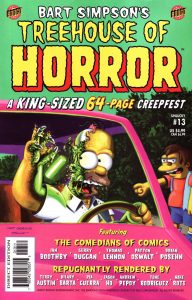
Bart Simpsons Treehouse of Horror (2008) 13
Brian Posehn and Gerry Duggan lead off the book with a parody of Jaws called Gnaws. The turgid tale read more like a Mad magazine lampoon with the minor characters taking center stage. Chief Wiggum, Captain Horatio McCallister and Professor John Frink provide the punchlines.
Jaws became the first summer blockbuster the year after Peter Benchley’s novel hit bookstores. Director Stephen Spielberg became a household name and John Williams’ score became a seaside anthem.
It would go on to become the number-one box office money maker until Star Wars hit theaters two years later.
Lenny stars in They Draw, an unabashed swipe from wrestling legend Rowdy Roddy Piper’s sci-fi vehicle They Live. Rather than seeing aliens, Homer’s second banana sees beyond the printed page.
Patton Oswalt spawns They Draw.
They Live was based on the short story Eight O’Clock in the Morning by Ray Nelson. John Carpenter’s commentary on society was criticized even though it debuted at number one in North America. It now has a cult following as do so many of his celluloid ventures.
Bart, Homer, Lisa and Milhouse find themselves sucked into some of Hollywood’s biggest movies when they encounter cursed props. Prop, Prop, Whiz, Whiz dusts off some whimsy to enter the silver scream.
Ian Boothby and Pia Guerra pen the tale.
Bart turns the tables on Montgomery Burns in The Pygmy Elixir. Seeking youth, Burns must enlist the aid of Bart. Their trip to the Amazon has mixed results.
The saucy story is courtesy of Thomas Lennon.


Bart Simpson’s Treehouse of Horror (2006) 12
Homer taxes God’s patience when tapped to become the world’s savior in Homer’s Ark!
Well, maybe.
The story may have been a dream. Much like the Bible, the end result is based on interpretation. However, the titular character is struck with God’s wrath for a fitting end to the tale.
Blood Curse of the Evil Faries! proves a lackluster story rooted in Homer’s child-like existence and disregard for anyone, but himself. Maggie must save the Simpsons, but leave the audience wanting more.
Groundskeeper Willie embraces a taboo love in Willie: Portrait of a Groundskeeper. With his usual disdain for platitudes beyond his, Homer destroys the partnership of human and bird only to suffer the same consequences when Willie serves up Marge for dinner.
Not as satisfying as years past, but another serviceable installment for the Halloween season.
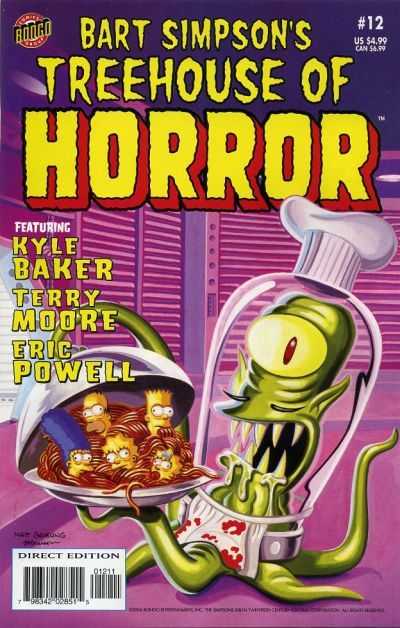


Bart Simpson’s Treehouse of Horror (2005) 11
Issue 11 takes readers back to an era when voters liked Ike, but loved Lucy. When comic books sold in the millions on a monthly basis. To a time when horror bared its fangs under the guidance of man who later would be called Mad.
The Sub-Basement of Dracula reunites the legendary duo of Marv Wolfman and Gene Colan. Both shepherded the Prince of Darkness through his run at Marvel Comics during the 1970s. While not the original author of Tomb of Dracula, Wolfman came on board with issue seven seeing the book through to it’s ending journey with issue 70.
Neither creator spare the jugular as Bart, Homer, Marge, Lisa and, even, Maggie assume the roles of Quincy Harker the Van Helsings and Blade.
Not to be outdone, Len Wein and Bernie Wrightson revisit their muck monster in Squish Thing. This loosely veiled send up of Swamp Thing brings vengeance at the hands of a vegetative Homer who saves his love from Moe.
Swamp Thing first appeared in House of Secrets (1956) 92 as envisioned by Wein and Wrightson. The one-and-done proved successful enough, the two were asked for a continuing series. Wein helmed the book for the first 13 issues while Wrightson left after the first 10.
The title has appeared off and on spin racks ever since, including two movies, an animated feature and two live-action television series.
Two Tickets to Heck; A Quick Way to a Krusty Death!; Bart Simpson Midget Commando; Krash! Shock! Suspense! Simpsons! and Blast From the Future Past! all doff their hats to the original series of EC comics.
Chris Bonham and Steve Ringgenberg pen the shorts with art by James Lloyd, Angelo Torres, John Sevrin, and Mark Shultz.
-
- Bart Simpson’s Treehouse of Horror (2005) 11
-
- Bart Simpson’s Treehouse of Horror (2005) 11


Bart Simpson’s Treehouse of Horror (2004) 10
Marge’s night of indiscriminate passion leads to a new evil unleashed on Earth.
Bart Simmons God of Thunder, as told by Gene Simmons, is as full of machismo as the author. The brash and bawdy tale doesn’t spare the Kiss references, either.
The protagonist is as much an antagonist for much of the story. His demon-given birth rite, powered by his pre-pubescent imagination fractures reality. Only when challenged from above does he rise to meet the challenge and save Earth.
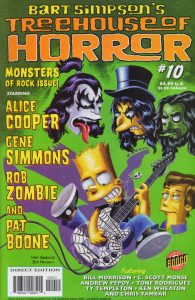
Bart Simpson’s Treehouse of Horror (2004) 10
For those not familiar with Simmons, the aging glam rocker co-founded Kiss in the early 1970s. The bass player is an unabashed fan of comic books and monsters. His costume was designed from both.
Shock rocker Alice Cooper is less predator than prey in The Legend of Batterface.
Cooper mixes a little Friday the Thirteenth with Carrie as Homer becomes a perennial killer. His modus operandi are donuts. A carefully culled phrase from his youth brings out a murderous rage as Homer exacts revenge for a long ago wrong.
Vincent Damon Furnier adopted the stage moniker Alice Cooper after shedding his initial band of the same name. The Detroit-based musician used an amalgam of musical noirs for the sound they unleashed in the early 1970s.
House of a 1000 Corpses is deconstructed for House of a Thousand Donuts when the Simpsons take a vacation.
Rob Zombie liberally steals from his first movie. Homer, Marge and the kids are subjected to a night of terror when the patriarch visits Dr. Satan’s Hall of Donuts. Krusty’s twist ending is no surprise to any who have seen the source material.
Zombie is best known as a musician. Before embarking on a solo career, the singer fronted White Zombie. He would go solo in 1998. In 2003, he turned his attention to cinema and wrote, directed and co-scored House of a 1000 Corpses. Since then, Zombie has written and directed The Devil’s Rejects, Halloween (2007) and Halloween II (2008), Werewolf Women of the SS, The Haunted World of El Superbeasto, The Lords of Salem, 31 and 3 From Hell.
The trifecta of hard rock authors is complimented by Top 40 favorite Pat Boone.
His Scareway to Heaven features Ned Flanders and a Bible camp massacre.
Boone has sold more than 45-million records, had 38 top 40 hits and appeared in more than 12 Hollywood films. His wholesome persona made him the darling of the 1950s song scene, second only to Elvis Presley.
You can almost hear Vincent Price’s voice echoing a sentiment from Thriller as the book closes.


The Simpsons’ Treehouse of Horrors (2013) 19
Halloween ’13 and the 19th issue of The Simpsons’ Treehouse of Horrors.
Spoiler alert, as if the cover wouldn’t give it away, this is an all-alien issue with a little love(craft) to cap the book off.
Monster Mash-Up is ploy by Kang and Kodos Johnson to subvert humans to their will. Homer foils their plans when confronted with a choice between food and love.
Ian Boothby and Tone Rodriguez twist a tale common enough for so many in Alienated!
Finally, comic-book legend Len Wein resurrects an old evil nearing its centennial birthday with Cthulhu. Like the first two stories, it is revealed to be a farce with an O’Henry ending.
Cthulhu was the fictional, cosmic child of H.P. Lovecraft. The Call of Cthulhu was first published in Weird Tales in 1928.
The story became a pied piper for fantasy enthusiasts. It has become the subject of many multi-media projects. Cthulhu made a short appearance at the beginning of The Simpsons’ Treehouse of Horror XXIX.
In the episode, television’s first dysfunctional animated family go to Fogburyport to visit the birthplace of Green Clam Chowder. They soon learn the destination is a trap designed to bring fresh food to Cthulhu.
The Treehouse of Horror episodes began Oct. 25, 1990. Comprised of three vignettes, the shows became perennial favorites among viewers and critics. Treehouse of Horror VI, Treehouse of Horror XXIII and Treehouse of Horror XXV were each nominated for the Primetime Emmy Award for Outstanding Animated Program (for Programming Less Than One Hour).