

Archive for the ‘DC Comics’ Category
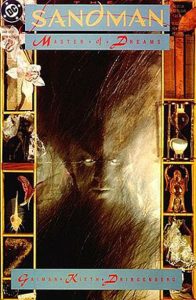
Sandman (1989) 1
Sandman (1989) 1
Dream, the repository of stories, hosts National Book Lovers Day for you and us.
Escaping the fertile mind of Neil Gaiman, Sandman began publication in 1989. Initially Gaiman wanted to resurrect the Bronze Age Joe Simon and Michael Fleisher incarnation. When that didn’t happen, Gaiman was given free rein to create his own universe. One that enveloped the existing DCU, peeking around the edges.
For 70 issues and one special, Gaiman followed Morpheus as he returned to his realm and sowed the seeds of his own destruction in hubris.
Characters flowed in and out of issues, often times stealing the spotlight from the title character. Family showed as the Endless unfolded. Others became stars or were welcomed back to the literary world.
During its run, Sandman was recognized with the Harvey, Eisner, Inkpot, World Fantasy and Comic Buyers Guide awards. It continues to remain in publication in various hardcover and trade paperback forms.
Celebrate the printed word with – what else? – a book or comic book. Discover far off worlds or the one you live in.
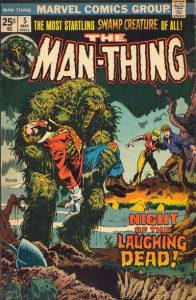
Man-Thing (1974) 5
Steve Gerber and Mike Ploog combine for the chilling And When I died…! for our macabre salute to International Clown Week.
Let’s face it, clowns are the yin and yang of our childhoods. They either tickle our funny bones or terrify our souls.
International Clown Week, the first week of August, is to remember them as the fall guys of the circus. Clown week began in the 1950s, courtesy of Walt “Wabo” Savage. At least he’s believed to be the originator.
Man-Thing (1974) 5
Ray Bickford, then president of the Clown Club of America, appointed Frank Kelly as the first International Clown Week chairman in 1966. President Richard M. Nixon proclaimed the first National Clown Week in 1970.
The representative we recognize is a clown named Darrel. His laughter had faded long before the retort of the pistol that took his life. Over the love of a woman. The love of a woman and the mistaken belief she had taken that love back.
His ghost lingered long enough to exact revenge on those who tainted that love and turned the painted crimson grin upside down.
As with many of the Man-Thing tales, the title character is more host to the story than member of it. One swipe of his muck-encrusted arm is enough to bring justice to the villains.
Man-Thing began in Savage Tales (1971) issue one. The swamp creature sloughed his way to Adventure into Fear issue 10 for a solo story. There he remained until issue 19 when he shambled into his own book. The first book ran 22 issues with five giant-size comics from 1974 to 1975.
The second run, 1979 to 1981, ran 11 issues. Afterward, Man-Thing bounced from feature to feature as well as guest starring with the remainder of the Marvel Universe.
To celebrate the week, show the world the clown you are in private.
Mister Miracle (1971) 1
Granny Goodness is our glamor girl for Gorgeous Grandma Day.
Oh, yes, there is such a thing, and has been since 1984. Alice Solomon created the non-holiday to celebrate “women of certain age.” That age is not specified, but the grandmothers in the spotlight are to be honored for their accomplishments and abilities.

Mister Miracle (1971) 1
Jack Kirby’s Phyllis Diller inspired baddie may not be a prime example of what Solomon wanted, but she’s our centerfold.
The villainess is a master of brainwashing and torture used to mold her charges into ruthless warriors. All in the service of Darkseid’s name.
Her one disappointment is the escape of Scott Free from her orphanage. Free, or Mister Miracle, is the son of the Highfather of New Genesis. He had been used as bargaining chip for peace between New Genesis and Apokolips.
Beyond her superhuman strength and endurance, Granny is immortal. She has been schooled at hand-to-hand combat and is resistant to most physical attacks.
Ed Asner was tapped to voice her animated appearances in Superman: The Animated Series, Justice League Unlimited and Superman/Batman: Apocalypse.
According to National Day Calendar, “Gorgeous Grandma Day embraces the age of the nana and encourages all women to flaunt their granny attitudes with purpose and style.”
To celebrate, grandmothers are encouraged to show the world their gorgeous selves.
Sgt. Rock (1977) 350
Before Sgt. Rock was relegated to seasonal stories and minis, he was the Top Kick of Easy Co. from 1959 to 1988.
During his time in service to his country, Frank Rock served from the shores of Italy across the Rhine and into the heart of the Fatherland. All the while shepherded by creator and chief scribe Robert Kanigher.

Sgt. Rock (1977) 350
Having survived the backlash from the Viet Nam conflict, Rock was moved from Our Army at War to his own title in 1977. He would continue through most of the 1980s to issue 422 only to fall victim to Crisis on Infinite Earths.
But, for the winter of 1980, Rock and Easy were on the front lines in ‘Home for Christmas.’
A missing G.I. takes the sergeant from his men during the holiday season. Most of the story is spent with Rock recounting his interaction with the AWOL soldier.
The missing man’s mantra throughout the war was to be “home for Christmas”. With the holiday fast approaching, Rock fears the wayward private has left the war early to be back with his family.
What he finds is a heartwarming sight that turns heart wrenching. However, in true DC war fashion both soldier and Easy are saved by story’s end.
The book is rounded out with a two-page Battle Album focusing on types of gases. Also included are stories ‘The Last Knight,’ ‘Roman Nose’ and ‘The Men of Easy Co.: Right Arm.’
Following his regular-series run, Rock returned for cameos and seasonal one-and-dones. He was also featured in a 21-issue run of reprints and two specials.
Green Lantern (1960) 23
If the idea of ever inking up ever crossed your mind, today may be the day. July 17 is observed as National Tattoo Day.

Green Lantern (1960) 23
Singing the praises of indelible images inked on your body is Green Lantern’s arch nemesis, the Tattooed Man.
Tattooed Man began his career as a sailor-cum-burglar. Abel Tarrant was the victim of undisclosed chemicals bestowing upon him the ability to create three-dimensional objects from his ink.
His initial appearance was less than spectacular. To offset his losses, Tattooed Man joined the Injustice Gang seeking safety in numbers. Later he would be believed murdered by the Goldface mob.
He would return for the third volume of Green Lantern following Crisis on Infinite Earths. His brush with Guy Gardner, in issue two, didn’t deter his determination to go straight. Tarrant was not seen again until Hal Jordan’s funeral in issue 81.
John Oakes was the second to assume the Tattooed Man persona. His powers were of a more supernatural bent.
Mark Richards became the third incarnation. His tattoos bore his sins against humanity. His demise occurred during Heroes in Crisis.
Sailors bearing mementos of their journeys abroad brought the art to America. Early on they carried a stigma. Now there is a new found acceptance of tattoos which have become popular in the past 10 years.
Those considering a tattoo should remember to find a reputable artist. Decide upon a design. Check spelling if any is involved. Be prepared to pay.
To celebrate, share your ink on #NationalTattooDay.
Sugar and Spike (1956) 44
Sugar and Spike find parenting isn’t as hard as grown-ups would have them believe in ‘Santa’s Parents.’

Sugar and Spike (1956) 44
In another misunderstanding, the two tykes find themselves fending for themselves. Finding a remote control only brings more confusion to the holiday season as Santa does his job only too well courtesy of Sugar and Spike.
All is forgiven when the unexpected publicity brings mountains of money.
‘Little Arthur’s War’ is the second act. Santa dispenses justice rather than coal for the bratty Arthur.
Arthur gets his revenge – briefly – as he wreaks havoc with the push of a few buttons in act three. His reign of terror is ended and his destruction tallied in dollars and sense.
The final part of the four-act adventure is a lesson for the parents, who are taught they are never too old to learn.
Tucked between stories are some one-page funnies and a chance to make some greeting cards.
Maybe the sum and total of the book is another December survival.
Elvira’s House of Mystery (1986) 8
No real 4th of July celebration this issue; just three-tired tales to stretch out the 18 pages between covers.
In addition to DC, Elvira also appeared in Eclipse and Claypool comics. Her residence at DC was short-lived, a mere 11 issues and a Christmas special.
Elvira is the alter ego of Cassandra Peterson. The Mistress of the Dark first appeared on KHJ-TV as a horror host in 1981. By 1985 her fame spread as she released a series of VHS tapes of her show. In 1988 she starred in her first film, Elvira: Mistress of the Dark. It wasn’t until 2000 she appeared in a sequel, Elvira’s Haunted Hills.
The Fourth of July, or Independence Day, commemorates the Declaration of Independence. The federal holiday is traditionally observed with picnics, fireworks and patriotic displays.

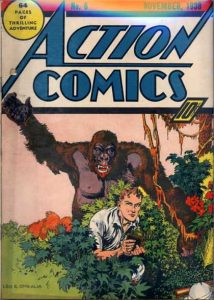
Action Comics (1938) 6
Smile pretty and polish your lens, it’s National Camera Day.
Action Comics (1938) 6
Last year Peter Parker/Spider-Man emceed festivities. This year we’re tapping Jimmy Olsen as the freckled face of the (non) holiday.
The Daily Planet’s chief shutterbug’s first appearance is questionable. Action Comics issue six has a bow-tie wearing office boy, but his name wasn’t mentioned until the April 15, 1940, episode of the Superman radio show.
It wasn’t until Superman (1939) issue 13 in late 1941 the name Jimmy Olsen appeared in a comic book. His popularity grew enough that by 1954 Jimmy had his own book, Superman’s Pal Jimmy Olsen. It would last until 1974 when it was merged with The Superman Family book.
Crises and reboots have not been able to dislodge Olsen from Superman’s coattails. His character and (marginal) popularity continue to this day.
To celebrate the day, snap a photo of someone close to preserve the memory. Photos can be shared by using #NationalCameraDay.
Joker (1975) 1
Who better to represent the non-holiday National Smile Power Day than one of comic book’s toothiest characters, the Joker.
No one else in the DCU has made it his mission to make others smile the way the Joker has. Since his first appearance in Batman (1940) issue one, the Harlequin of Hate has set his sights on chaos with a smile.
The Joker began as a psychopath before being toned down for the 1950s and into the ‘60s. The prankster persona was put to rest by Denny O’Neil and Neal Adams in Batman 251, ‘The Joker’s Five-Way Revenge.’

Joker (1975) 1
The Clown Prince of Crime would continue down his dark path with The Killing Joke in 1988. In the prestige one shot, Joker would shoot and cripple Barbara Gordon. A year later he would kill Jason Todd, the second Robin, in ‘A Death in the Family.’
In 2011 ‘Death of a Family’ would exam the Joker’s relationship with not only the Dark Knight, but the rest of the Bat family.
The comic book pictured in conjunction with today’s non-holiday is the first issue of Joker’s all-too-short-lived, self-titled book. Joker ran nine issues beginning May-June, 1975 through September-October, 1976.
Each issue featured a one-and-done story, usually guest-starring a hero or villain from the DCU.
Issue 10 was scheduled to be published, the first part of ’99 and 99/100% Dead.’ It did not see print until Aug. 14, 2019.
To celebrate National Smile Power Day, challenge yourself to smile more often.
Adventure Comics (1938) 210
Krypto the Super Dog represents our four-legged friend for National Dog Day.
Whether purebred or a mutt from the street, dogs bring love to peoples lives. It is only fitting our canine compatriots are given their day.
To observe, consider adopting your own pooch. If that’s a bit extreme for your lifestyle, we suggest some virtual pet ownership through reading. More specifically, with Superboy/Superman’s dog, Krypto.
Adventure Comics (1938) 210
(Super)man’s best friend first appeared in Adventure Comics 210. He was Kal-El’s dog on Krypton. Jor-El tapped Krypto to test an earlier model of rocket. A quirk of fate brought the forlorn Fido to Earth to be reunited with his master.
Under the yellow sun, Krypto’s abilities were enhanced as well. The crime-fighting canine was given a yellow collar with the “S” emblem and a red cape to complement Superboy’s.
Krypto would go on to become a member of the 30th century’s Legion of Super Pets and the Space Canine Patrol Agents. He would have his own feature beginning in The Superman Family issue 182. This ran for 10 issues.
Krypto no longer existed after Crisis on Infinite Earths. Not at first. He would be reintroduced, as would so much of what had been erased during the original crisis. Krypto would go from an ordinary dog with augmented powers to a canine from Krypton once again. The New 52 would take those powers away only to have them restored with DC Rebirth.
The world’s mightiest dog has appeared in most incarnations of the animated DCU beginning with cameos in 1966’s The Adventures of Superboy. In 2005 Cartoon Network gave Krypto his own series simply titled Krypto the Superdog.
He was also mentioned in the live action Smallville.
Krypto has further appeared in DC Universe Online, Lego Batman 2: DC Super heroes, Lego Batman 3: Beyond Gotham, Infinite Crisis and Lego DC Super Villains games.
Use #NationalDogDay to recognize your love of dogs today.