

Archive for the ‘DC Comics’ Category
Super Friends (1976) 28
Masquerade of Madness is a true Halloween story.

Super Friends (1976) 28
Published Oct. 25, 1979, E. Nelson Bridwell and Ramona Fradon craft some late Bronze Age cheesiness. Basically, werewolf Jimmy Olsen, Jayna and Zan end Felix Faust’s plans to defeat the Super Friends once and for all.
The Super Friends began as Saturday morning fodder for sugar-addled brains starved for a more kinetic version of their comic books. The original series premiered in 1973 after the Dynamic Duo tested on Scooby-Doo and Wonder Woman on the animated Brady Kids.
It was rechristened as The All-New Super Friends Hour from 1977-78. Further name changes included Challenge of the Super Friends from ’78 to ’79, The World’s Greatest Super Friends ’79 to ’80 with a return to simply Super Friends from 1980 to 1983.
Hanna-Barbera finished out its run with Super Friends: The Legendary Super Powers Show from 1984 to 1985 and, finally, The Super Powers Team: Galactic Guardians, 1985-86.
While loosely based on the Justice League of America comic book, Super Friends did not translate into a comic book itself until 1975. Even that relied heavily on the JLA. Super Friends began as part of the Limited Collector’s Edition (C-41) series, reprinting JLA issues 36 and 61 with Bridwell penning a bridging tale to bind the stories together. Alex Toth provided pencils.
DC finally greenlit a Super Friends comic book series in 1976. The title ran till 1981. The comic complimented the cartoon rather than rely on JLA continuity.
Not sure if this is a trick or treat, but if you happen across it in a back-issue bin, enjoy some past history.
You Can’t Beat This Halloween Treat!
DC rolled out the red carpet for Halloween 1979.
Featured in the house advertisement are Secrets of Haunted House 20, House of Mystery 276, Weird War Tales 83 and Ghosts 84. Showcased was Super Friends 28 touted as a “Hair Raising Chiller!”
According to the hype, “The Super Friends Battle 5-Fearsome Foes…and their Mysterious Master!”
To learn more about the issue, tune in tomorrow for the full synopsis.
In the meantime, continue to dig out DC’s anthology House books and Marvel’s serialized monster soaps with Universally-recognized names. Let them take you back to the days of Ben Cooper costumes, plastic Jack o’ Lantern candy buckets and gobs of sugary candies.

You Can’t Beat This Halloween Treat!
Franklin Richards Monster Mash (2007) 1
Franklin sets out to prove his classmates wrong in Ready, Steady, Yeti.
With H.E.R.B.I.E. in tow, the two teleport to Mount Everest. The quickly complete their mission, to find the Abominable Snowman. The results are not what either expected.
Intestinal distress releases a monster no one expected as Franklin tackles his Little Monster; it’s not as dirty as it sounds.

Franklin Richards Monster Mash (2007) 1
Not until help from an unexpected source intercedes does Franklin learn to control the forces insides him.
Ghost in the Machine is not only the best album by the Police, but the third story in the book.
Franklin uses one of his father’s machines to turn the tables on his doubting dad. The story quickly degenerates into a Casper clone complete with the Ghostly trio. In the end, it’s Franklin who learns the lesson.
Under the Bed has Franklin taking matters in hand, behind his father’s back. He and H.E.R.B.I.E. return an interdimensional monster back to its home.
Power Trip shows Franklin how dirty the super hero business can be at times.
Another fun trip into the world of the FF’s heir apparent.
Realworlds Justice League of America (2000)
Realworlds Justice League of America bears more than a passing resemblance to Stephen King’s Stand By Me. Or, The Body if you are referring to King’s novella from the 1982 Different Seasons hardcover from which the screenplay blossomed.
J.M. DeMatteis’ millennial-prestige edition even manages a dash of King’s It for good measure. But, mostly Stand by Me. Right down to the, “It’s been said that no matter how far you travel in life, you’ll never have friends like the ones you had when you were 10,” line.

Realworlds Justice League of America (2000)
Stand by Me/The Body is not a bad story to swipe from. Neither is It.
The difference is DeMatteis uses a more mundane excuse to bring the former childhood friends together. Return of the Justice League has no corpse to focus on. Nor does a nigh-immortal evil dressed in clown garb terrorize a generation.
Return of the Justice League just uses longing. A longing to be 10 again. To experience friendship – real friendship – for the first time. To return to a time when whimsy and fantasy were allowed in lives.
One by one, the former gang of Richard Barrison, Nick DiMarco, Michael Riley and Karen Steuben are contacted. Each are flown home to relive a day from their past.
Only when they allow themselves to be immersed in yesterday do they realize what they’ve missed and what they have to look forward to.
Return of the Justice League is a return to youth on Halloween and Halloween eve. For the cost of a costume and imagination Richard, Nick, Michael and Karen are richly rewarded.
Young Justice (1998) 3
Another in a string of Happy Halloween reminders to Four Color readers. Today we’ve tapped Young Justice to herald the holiday.
Young Justice began as a bridge between Teen Titan teams. Originally the group consisted of Superboy, Robin and Impulse first tossed together in the GirlFrenzy one-shot. They next teamed in the World Without Grown-Ups mini-series before earning an ongoing title in 1998.

Young Justice (1998) 3
Red Tornado became their “guardian” and were later joined by Wonder Girl, Secret and Arrowette.
Young Justice ended as it began, serving the greater good of the Teen Titans. Titans/Young Justice: Graduation Day was a three-issue mini leading into a new Teen Titans cartoon. Though billed as a maturation process for the characters, licensing proved too lucrative for art.
Issue three worked as an early example of what would come. Peter David and Todd Nauck crafted a Halloween tale that has little to do with October 31, but everything to do with the title.
Mr. Mxyzptlk makes a guest appearance in The Issue Before the One Where the Girls Show Up. Young Justice has agreed to host a Hallow-Teen Party. The fourth-dimension’s most notorious resident works on his thesis of three-dimensional primitive life forms only to be unwittingly shocked back to his former state of prankster.
This is a priceless bit of late 1990’s fun courtesy of Mr. David. The dialog is witty and relevant, right down to the Hason reference by Impulse.
As mentioned above, all good things must end and the series was cancelled by issue 55.
Drown your sorrows with some sugary treats and remember the good times that included several specials to compliment the regular series.
Sugar and Spike (1956) 37
Another not-so-haunting issue for Halloween 2020.
Sugar and Spike were created by Sheldon Mayer with the self-titled book running 98 issues, 1956 to 1971. It was a much simpler time when the books began and many wish for a return to such by the book’s finish.
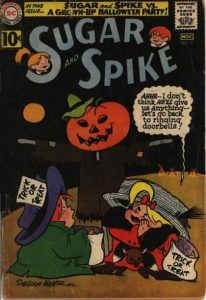
Sugar and Spike (1956) 37
Issue 37 is from 1961, when Camelot was still forming, Viet Nam was as distant in thought as proximity and the space race was far from won.
Halloween Monster has the two tots discovering Halloween. How they were never taken from their parents must be attributed to the times, but the kids are left alone while the parents partied.
Learning they are alone; Sugar and Spike sneak a peek at festivities across the yard. Neither can comprehend the costumed grown-ups devouring all the food in sight.
The two marshal their moxie and march next door to save the horderves. Their plan is discovered and the adults laugh at the two they believe are attempting to steal food.
When Mayer’s eyesight became too bad to continue, the book it was cancelled. Cameos were worked in over the years until Keith Giffen and Bliquis Evely had the pair grow up and become private eyes in Legends of Tomorrow.
Happy Halloween from a simpler time.
Looney Tunes (1994) 155
Every Witch Way has Witch Hazel stomping through the fairy tales. All with Bugs as her agent earning his 15 percent the hard way.
Daffy Duck shows even Gossamer can have a new look in Bad Scare Day.
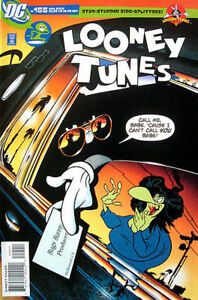
Looney Tunes (1994) 155
Finally, Sylvester sheds eight of his nine lives with Elmer in House of Horror in another take on the couple’s haunted house routine.
Looney Tunes has been a staple of the four-color community since Dell Publishing first offered Looney Tunes and Merrie Melodies Comics beginning in 1941 and continuing to 1955. The success of the original book led to Bugs’ self-titled book the following year. It ran from 1942 to 1962.
Porky Pig, Tweety and Sylvester, Daffy Duck and the Road Runner all had their own books, as well.
Gold Key/Whitman licensed the Looney Tunes gang from 1962 to 1984. Numbering picked up from Dell’s books.
After a 10-year hiatus, Bugs and gang returned to the comic book racks in 1993 with a three-issue Bugs Bunny mini. The main Looney Tunes book began in 1994.
Secret Origins (1986) 44
It’s time to get a little muddy today – in honor of National Mudpack Day.
Mud Pack is the colloquial name for Basil Karlo, Preston Payne and Sondra Fuller, the four original Clay Face personalities. That’s how we’re tying in National Mudpack Day and comic books.
The unofficial holiday celebrates the practice of mixing water and dirt to smear on one’s self. Mud packs are reputed to be therapeutic. Rumored benefits include increased circulation, the easing of muscle tension, releasing of toxins and boosting of immunity.
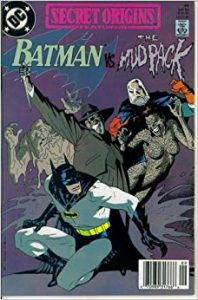
Secret Origins 44
Our Mud Pack is a fictional group of Batman villains.
The Golden Age Clay Face is Karlo, first introduced in Detective Comics (1937) 40. The addled and aging actor was not invited to reprise a movie role and goes on a murder spree.
He next appeared in Batman (1940) issue 208 and Detective 496.
Matt Hagen is the heir apparent, first appearing in Detective Comics 298. Rather than acting, the second Clay Face is a treasure hunter. His discovery of a radioactive ooze does not go well and he finds himself a literal clay being.
Preston Payne is next in line for the title. His first appearance is Detective 477. A STAR Labs employee, his is a more tragic origin. The search for a cure goes unfulfilled and ending in tragedy.
Sondra Fuller is the fourth installment in the line-up. She first appeared in Outsiders (1983) 21, transformed into a shape changer by Kobra technologies.
Cassisus “Clay” Payne is the love child of Payne and Fuller. He first appeared in Batman 550.
Clay Face number six also debuted in Batman 550. Dr. Peter “Claything” Malley is a clone of Cassius Payne.
Todd Russell premiered in Catwoman (2002) issue one. Russell is more of a serial killer preying on prostitutes.
Finally, to date, is Johnny Williams. Williams first appeared in Gotham Knights 60 and was a former firefighter who became the mud monster after a mishap at a chemical plant fire.
Several other versions have cropped up throughout the DCU and in other media.
So, if you’re getting dirty, make sure your hands are clean before reading any comic books featuring the above-mentioned villains.
Action Comics (1938) 159
Today we celebrate a day of work by not working; today is Labor Day.
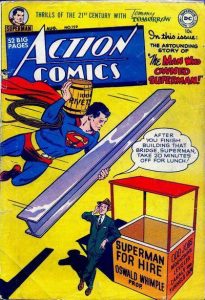
Action Comics (1938) 159
As evidenced by the cover of Action Comics 159, Superman is going to be doing the heavy lifting.
This August, 1951, dated issue comes from a simpler time. One when readers would plunk down a dime for a story in which Lois Lane convinces Superman to sign a promissory note agreeing to perform all her wishes over a three-day period. The paper is lost, only to be found by Oscar Whimple, who proceeds to work the Man of Steel like a dog.
Also, included in this issue is Showdown in Suez! Starring Congo Bill. The character would later become a full-fledged ape known as Congorilla appearing in DC Comics Vertigo imprint.
Tommy Tomorrow appears in The Planeteer from the Past! The journeyman comic book character bounced through different DC titles from 1947 to 1963.
The Vigilante takes justice into his own hands in The Trigger Trail of ‘Wild’ Eddie Meeks! Greg Sanders, aka Greg Saunders, was the original Vigilante, riding the trails in the old west beginning in Action Comics 42.
An early origin of Labor Day is attributed to the Knights of Labor in 1882. Central Labor Union Secretary Matthew Maguire is credited with the proposal of a national holiday to celebrate the worker.
A second theory is Peter J. McGuire, vice president of the American Federation of Labor is the father of Labor Day.
Whichever the case, President Grover Cleveland backed a September commemoration and Labor Day became officially recognized as a federal holiday in 1894.
Looney Tunes (1994) 167
Happy Halloween.
Or, it should be. Frank Strom offers a candid view of Christmas commercialism and how the holiday is affecting other red-numbered calendar days.
Looney Tunes (1994) 167
Only two days to Halloween and Witch Hazel doesn’t have any candy. Simple enough solution. Hop on her broom and head to the local mega-mart.
But, it’s not that easy.
On Oct. 29, instead of Jack o’ Lanterns she finds Christmas trees, tinsel and other Tanenbaum trimmings. Halloween has been usurped.
After a warehouse interval, Hazel heads north – far north – to speak to the man in red himself. When she finally is granted an audience, Hazel has words with Santa. Those words lead to a truth the big man never considered.
Host Felix Faust follows with a one-page Super Friends Super Stumper.
Hazel returns for a romp through the fairy tales in Spell It Out and Bugs helps Porky Pig find a loophole to save his soul from Daffy “Devil” Duck.
Not a bad cover-to-cover read near the spookiest night of the year.