

Archive for October, 2022
Animaniacs (1995) 1
The second day in October is celebrated as the day Columbus discovered the Americas.
The first Columbus Day took place Oct. 12, 1792, to commemorate the 300th anniversary of the event. It was inaugurated by the Columbian Order of New York, better known as Tammany Hall.
One hundred years later, the 400th anniversary was declared a one-time event by President Benjamin Harrison. It was also a diplomatic bid to lessen the impact of the racially motivated murders of 11 Italian immigrants.
Colorado was the first to honor the day state wide with a proclamation in 1905. Not until 1934 and President Franklin D. Roosevelt was a proclamation issued from the oval office stating October 12 was Columbus Day, government officials must display the flag of the United States on all government buildings and inviting citizens to observe the day as Columbus Day.
President Lyndon B. Johnson was the president who signed legislation anointing October 12 officially as Columbus Day and a federal holiday in 1968 though the it was not enacted until 1971.
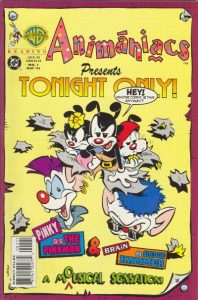
Animaniacs (1995) 1
Since 1971, Columbus Day has been observed on the second Monday in October, not October 12.
To celebrate, the WB’s Animaniacs take us on a sea cruise in 1492 The True Story.
Enroute to Asia, Christopher Columbus stumbles across the Warner Bros. – and sister, Dot – who hijack the adventure and show the seafaring seeker a better way to get where he’s going. Even if he wasn’t headed there.
Pinky and the Brain headline the first issue in Global Disorder.
The siblings commandeer the book with the second story, an untitled tale showcasing work behind the scenes on the WB lot.
The Animaniacs comic book ran a total of 59 issues. A Christmas special appeared the December prior to the ongoing books release.
Animaniacs the animated series was the brainchild of Tom Ruegger for the Fox Kids block. It would relocate to the WB in 1995 becoming part of the Kids’ WB offerings. The series was also a direct heir to Tiny Toons, part of Steven Spielberg’s Amblin Entertainment.
The show was second only to the Mighty Morphin Power Rangers on Fox and would pull in over one million viewers a day when it became part of the WB line up.
So, take the day to discover some recent classics by reliving either the television show or snuggling down with some back issues.
Detective Comics (1938) 510
Today we go down the rabbit hole for 24 hours of “silliness.”
National Mad Hatter Day is a day to explore the more whimsical side of our personalities. Modeled after Alice in Wonderland’s namesake, Mad Hatter Day teaches us to put aside the seriousness and unleash the silliness; ditch the dialectics for the doltish.
The fictional character was created by illustrator and political cartoonist, Sir John Tenniel. The phrase, mad as a hatter, is taken from him.
In the 19th century, hats were considered status symbols. The finer the “hat” couture, the higher the believed social standing. Hatter, his real name, became associated with wearing hats with labels. The 10/6 didn’t stand for a size, but the cost.
When National Mad Hatter Day was proposed, October 6 was chosen due to the 10/6 tucked in the hat band. It was inaugurated in 1986 by a group of computer programmers, then officially recognized in 1988.
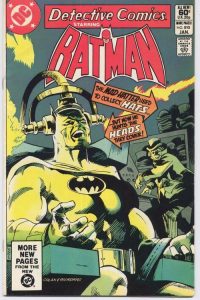
Detective Comics (1938) 510
Jervis Tetch is the easy emcee choice for the day.
Making his debut in Batman (1940) issue 49, Tetch is a technological talent able to craft mind control devices. Usually these are hidden in a hat or other headwear.
He is the child of Bill Finger and Lew Sayre Schwartz, first appearing in 1948.
His backstory consists of an unhealthy interest in both hats and Lewis Carroll’s Alice’s Adventures in Wonderland and the sequel, Through the Looking Glass. When agitated, the chapeau criminal reverts to rhyming often adding quotes from the Wonderland works.
Tetch would appear only once in the Golden Age of comic books. His Silver Age appearances would be explained away as made by an imposter. The original Tetch did not reappear until Detective Comics (1938) 510 in 1981.
His imposter would return also, but not until six years later in Detective Comics issue 573.
The Mad Hatter’s canonical comic book mind control devices were first used in Detective Comics 525.
Though impersonated in the comic books during the 1960’s, the character would appear several times on the live-action Batman series of the same decade. Tetch was portrayed by David Wayne.
Benedict Samuel would play the villain in the 2014-19 Gotham series and by Liam Crandle in the third season of Batwoman on The CW.
Ted Knight voiced the animated version of The Mad Hatter in The Batman/Superman Hour show. Roddy McDowall would do the honors for the Batman: The Animated Series, The New Batman Adventures, Superman: The Animated Series, Batman Beyond and Batman: The Brave and the Bold.
For the Young Justice Outsiders, Dwight Schultz brought the character to life with his vocalization.
The Mad Hatter has also appeared in the Lego Batman video games as well as Batman: Arkham.
So, rather than bother yourself with the question, “how is a raven like a writing desk,” go find some Batman back issues, a silly hat and enjoy a day away from sanity.
(Yes, we’ve used the Mad Hatter in a prior non-holiday, but why reinvent the wheel for a day tailor made for him?)
Funky Phantom (1972) 1
Not often do we get to celebrate two holidays for the price of one within a comic book, but we do today.
Calling on The Funky Phantom to act as emcee covers both National Get Funky Day and, as a ghost, Halloween month.
This Scooby-Doo clone mimicked the tone and plot of most Mystery Gang episodes. It loosely relied on the vernacular of the day with its title to entice young viewers to tune in on Saturday mornings.
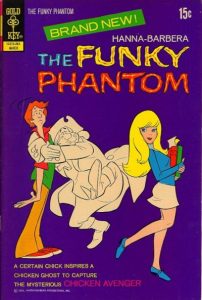
Funky Phantom (1972) 1 Gold Key
Overall, it was not one of Hannah-Barbera Productions best outings, but the animated series does have a certain dated charm after the passage of four decades.
The premise behind The Funky Phantom, as explained in the opening theme, had a trio of teens seeking shelter from a storm. Sneaking into an old house, they attempt to reset the grandfather clock only to unleash colonial-era poltergeists Jonathan Wellington “Mudsy” Muddlemore and his pet cat Boo. To escape British Redcoats during the Revolutionary War, the two hid inside the clock, but were unable to get back out and died within. Upon being released, the two buddy up with the teens and solve mysteries.
Mudsy may sound familiar to viewers. His voice acting was done by Daws Butler, better known as Snagglepuss.
The series lasted a mere 17 episodes while a comic book version saw 13 hit newsstands. Gold Key and Whitman each featured adaptations of animated episodes as well as original material.
Funk as a musical genre originated in the mid-1960s featuring a mixture of soul, jazz and rhythm and blues usi
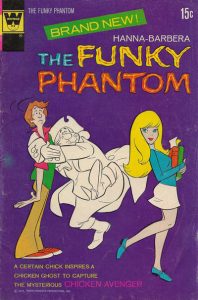
Funky Phantom (1972) 1 Whitman
ng the bass line as its guide.
The Godfather Soul James Brown is given much credit for streamlining the style. By 1976 funk had cemented itself in the mainstream that Wild Cherry produced a danceable one-hit wonder Play That Funky Music, White Boy that topped the charts September 18 of that year.
It wasn’t until after Hurricane Matthew hit Florida the Funkytown Fitness center in St. Augustine inaugurated National Get Funky Day on October 5 to get people out of “their comfort zones” and celebrate life.
To get in the groove, a recommended playlist includes: Give Up the Funk by Parliament, More Bounce to the Ounce by Zapp, Super Freak by Rick James, Brick House by the Commodores, Superstition and Higher Ground by Stevie Wonder, Get Down on It by Kook & the Gang, Funky Town by Lipps Inc and Sex Machine by James Brown.
Tex Avery’s Droopy (1995) 1
Dr. Droopenstein opens the month with a shot worthy of James Whale; brooding stonework towering into the shadows as streaks of lightning announce the birth pains of bringing a monster to life.
The atmosphere quickly dissolves by the next page when headliner, Droopy, opens his mouth and the mind “hears” the laconic drawl associated with the animated character.
A cloud as real as the ones outside hangs over Droopy as he realizes his experiment has failed. But, where to find a fresh brain this time of night?
To quote Matthew 7:7, “Ask, and you shall receive…”

Tex Avery’s Droopy (1995) #1
Receive Droopy does, in the form of arch nemesis McWolf.
The wayward wolf is only too happy to partake of Droopy’s hospitality. Doffing his rain-soaked jacket he makes himself comfortable by the fire. His demeanor is quick to change when the plot unfolds and his host begins to chase him around the castle wanting his brain.
Droopy is able to catch his fleetfooted friend when he comes across the shapely bride wrapped in gauze. The transfer is made, but the monster finds his new mate more than he bargained for.
Rod Serling is bashed in The Violent Zone, a parody of the 1959 anthology series in the book’s second installment.
The Twilight Zone ran five seasons, 1959 to 1964. Each episode would feature a fantasy or horror aspect and offer a twist ending.
Frankenstein; or The Modern Prometheus, began as a novel written by Mary Shelley. The original text bore a passing resemblance to Whale’s screen adaptation.
The monster became an icon four years later when the director made Bride of Frankenstein in 1935. Bride was highly praised upon its release and was added to the United States National Film Registry in 1998. Empire Magazine selected it as one of the greatest 500 movies of all time and Time Magazine praised it as one of the top 100 movies of all time.
This version was brought to life by Brian Lemay story and pencils and is the first of a trilogy of holiday spectacles offered by Dark Horse Comics. Thanksgiving and Christmas follow.
Howard the Duck (1979) 1
Not usually referred to as the oldest profession in the world, farming began approximately 12,000 years ago.
National Farmer’s Day commemorates the settlement of former hunters and the domestication of livestock October 12 each year.
Currently there are about two million farms in the United States. Those farms provide approximately $1 trillion dollars to the US economy. Each of those farms feed nearly 166 persons each year. Agricultural jobs sponsor 50,000 jobs per year.
No one is sure exactly when National Farmer’s Day began, though it was originally called National Old Farmer’s Day. The October 12 date is used due to the harvesting time frame. Normally this is at the end of harvesting allowing farmers a much-deserved break and time for revelry.
Howard the Duck (1979) 1
Representing the day is a Howard the Duck story from his inaugural magazine issue, Fowl of Fear!
Recovering from recent adventures detailed in the waning Howard the Duck comic book series, titular star, Beverly and her Uncle Lee drive back to Cleveland, OH, to start anew.
Along the way, some foreshadowing and reviewing is done before a blowout causes the traveling trio to seek shelter at an appropriately foreboding farm house on the hill.
They are received by the sinister Mr. Chicken who divulges his poultry program designed to increase the size and succulence of his commercially crafted chickens.
Mr. Chicken meets his deserved end with the help of Howard, Bev and Uncle Lee.
They continue their travels to Cleveland and eight more issues of adventures including a Christmas story in the third issue of his magazine.
Fowl of Fear is unremarkable beyond Bill Mantlo taking up animal rights regarding production of mass-produced foods early on in the struggle for decency in humane practices in those regards. Much has been documented over the years in relation to those operations.
The National Farmer’s Day observed today honors those humane methods of raising food to feed the world. Celebrate with something home grown and a little of the forward fowl who allowed us to look at ourselves and society with fresh eyes.