

Archive for the ‘Unofficial Holidays & Observances’ Category
Amazing Spider-Man (1963) 42
It seems so unfair to pack away the lively colors of Christmas during the blandest time of the year. To liven the month up a bit, let’s celebrate Kiss a Ginger Day.
Only two-percent of the world’s population can claim to be natural red heads. The shock of red tresses has been lauded and mocked, but always stand out in a crowd.
Maybe the most famous red head in comicdom, at least in the Marvel Universe, is Mary Jane Parker, formerly Mary Jane Watson.
MJ’s first appearance is technically Amazing Spider-Man (1963) 25, but normally considered Amazing Spider-Man (1963) 42.
In issue 25, the wily Steve Ditko, then penciling the book, hid her visage behind a plant. It was former romance artist John Romita, Sr., who immortalized her look in issue 42. In later interviews, the elder Romita admitted he patterned her after Ann Margret as she appeared in the movie Bye Bye Birdie.
Mary Jane would become Peter’s best girl until he could persuade Gwen Stacy to leave friend Harry Osburne. Following Gwen’s death at the hands of the Green Goblin, MJ and Peter entered a tumultuous relationship.

Amazing Spider-Man (1963) 42
By Amazing Spider-Man 182, Peter had asked Mary Jane to marry him.
She declined the offer.
The pair would drift apart for several years only to reunite. In Amazing Spider-Man 257 MJ admitted to knowing Peter’s secret identity.
They would continue to date and Peter would pop the question again in Amazing Spider-Man 290. This time Mary Jane would accept and the two were married in Amazing Spider-Man annual 21.
Married life was no less troubled than their previous dating one. MJ became pregnant, but complications due to the Clone Saga and editor’s whims left the baby stillborn.
Further marital problems ensued and Mary Jane left for the west coast. Eventually they reconciled only to be caught up in the Civil War storyline.
That was followed by the One More Day story arc in which Mary Jane accepts Mephisto’s offer to disappear from Peter’s life for the return of Aunt May who was killed during the previous marathon of a story.
This was followed by A New Life, Spider-Island, Ends of the Earth, Dying Wish and The Superior Spider-Man. MJ returned, but as a friend.
Peter and Mary Jane are reunited under Marvel’s Fresh Start relaunch event.
Mary Jane has been part of the Amazing Spider-Man landscape and Peter Parker’s life in every incarnation of the character. Her opening line for their introduction in Amazing Spider-Man 42 has proved truer than Stan Lee or John Romita, Sr., could have ever known,” Face it, Tiger, you just hit the jackpot.”
So did we.
Welcome to Kiss a Ginger Day.
If you are fortunate enough to know one, plant a wet one on their cheek and let ‘em know they are appreciated.
Black Lightning (1977) 1
If you feel the hair rising up on the back of your neck – head and other body parts – it’s an omen today is National Static Electricity Day.
Welcome to another non-holiday allowing the process of transferring electrons from one object to another. This is done through friction (triboelectric effect), conduction and induction.
While zapping someone’s ear or nose may seem harmless enough, the effect can be dangerous in the case of flammable gasses or a high concentration of oxygen.

Black Lighting (1977) 1
To celebrate today, learn more about electrostatic discharge, conduct experiments on the effects of static electricity, learn how to avoid static during winter months or, the one we recommend, read some of DC’s blaxploitation: Black Lighting.
Tony Isabella and Trevor Von Eeden created DC’s first African-American superhero, launching him with his own series. The title lasted a mere 11 issues, dying off in September-October 1978.
Jefferson Pierce, aka Black Lighting, came complete with superhuman powers afforded him via a belt. Later incarnations would give him the same abilities courtesy of a metagene.
Isabella was veteran of the Marvel method, having written Luke Cage. Like Cage, Pierce spoke with a 1970s black vernacular, topped with mask and afro for good measure.
He would later become a founding member of Batman’s Outsiders. He would also be offered Justice League of America membership only to decline originally. Later incarnations would bring him into the JLA’s fold.
When the New 52 debuted, Black Lighting was called back to duty and again with DC Rebirth. He began in Detective Comics before graduating to Batman & the Outsiders.
A live-action series appeared on The CW in 2018 starring Cress Williams.
For previous emcees, please refer to Electro in 2020 or Electro in 2021. No, that wasn’t a typo.
Deadpool (1997) 1
About 46 million people around the world are blind. Today is a day we can remember and honor their independence with World Braille Day.
Through a sequence of interrelated events, Louis Braille invented the series of raised dots named after its creator allowing the blind and vision impaired the ability to read.
Braille lost his sight following an accident at his father’s harness shop when he was three. While attending the National Institute for Blind Children in Paris, he cultivated an interest in music. That interest, combined with code communication developed for Napoleon’s army, were the basis for what is known as braille today.
He died in 1852, two years before France’s Royal Institute for the Blind Youth adopted a braille curriculum.

Deadpool (1997) 1
Representing the comic community for today is Blind Al, or Althea or Blind Alfred, of Deadpool fame.
Blind Al’s origin is murky at best, but at some point Deadpool took the geriatric gal hostage, keeping her as a companion/housekeeper/victim. Though his most intimate companion, Deadpool is incredibly cruel toward her. To punish Blind Al, Wade would put her in the Box, a small room filled with sharp objects. She was forbidden visitors, though she has become familiar with Deadpool’s other human tool, Weasel.
She was eventually released from his imprisonment, though she remained in contact with Deadpool over the subsequent years. Her last contact, to date, with the Merc with a Mouth was an invitation to he and Shikklah’s wedding. A misprint in the braille invite sent her to a gang funeral instead.
Blind Al was featured in both the 2016 and 2018 Deadpool feature films. She was portrayed by Leslie Uggams.
To participate, pay more attention to the braille and other accessible items available for the blind and vision impaired. In addition, learn more about its creator and famous people who were blind or visually impaired.
For a real treat, take in Deadpool (1997) issue 11, With Great Power Comes Great Coincidence, in which he is transported back in time to parody the events of Amazing Spider-Man issue 47. Blind Al plays Aunt May. It’s a classic.
Dynomutt (1977) 1
With all thoughts focused on what’s gonna be under the tree this year – or how you’re gonna pay for it – don’t forget man’s best friend.
National Mutt Day, celebrated July 31 and Dec. 2 each year, is designed to alert people of the furry four-legged, non-pedigreed, possible future soulmates roaming without a home.
The American Society for the Prevention of Cruelty to Animals (ASPCA for short) estimates approximately 3.3 million dogs are placed in shelters every year. Most never leave.
To tug at those heartstrings, Dynomutt, Dog Wonder; is leading the pack today.
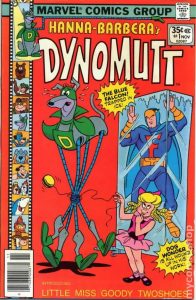
Dynomutt (1977) 1
For those not in the know, Dynomutt was a short-lived Hanna-Barbera creation borrowing from the Batman mythos debuting in 1976. Wonder Dog was a robotic dog sidekick to the square-jawed Blue Falcon airing on ABC Saturday mornings.
Marvel Comics published a bi-monthly comic book that lasted six issues from November of 1977 to September 1978.
The titular character was half of The Scooby-Doo/Dynomutt Hour for the 1976-77 season. He was relegated to a quarter of that hour during Scooby’s All-Star Laff-A-Lympics during the 1977-78 season.
Sixteen episodes made up the original season with a mere eight during his Laff-A-Lympic team-up.
Though brief, Dynomutt was put on the rerun rotation through 1980, first as Dynomutt, Dog Wonder and then as a second feature for The Godzilla/Dynomutt Hour. He would appear on Cartoon Network through the 1980s.
His memory was kept alive on Bommerang beginning in January of 2008 and continuing through March of that year. He returned in 2009 and remained in reruns till 2015.
All 16 episodes were released on home video by Warner Home.
Dynomutt and Blue Falcon would further guest on Scooby Doo! Mystery Incorporated’s episode Heart of Evil and co-star with Mystery Inc. in the original, straight-to-video Scooby-Doo! Mask of the Blue Falcon in 2013.
Those wishing to celebrate National Mutt Day beyond page and screen may do so by adopting a mutt of their own or at least volunteering at a local shelter.
Superman v. Nick O’Teen All Three Commercials
The Great American Smokeout is held the third Thursday in November each year to encourage smokers to quit their habit.
Sponsored by the American Cancer Society, the Smokeout is a 24-hour marathon of non-puffing. According to studies those who go 20 minutes without smoking see a decrease in their heartrate and blood pressure. After 12 hours, the body begins to cleanse the carbon monoxide from the last cigarette ingested. After one day, the risk of heart attack decreases along with heart disease and stroke.
Those holding out for two days experience a more profound sense of taste and smell. By day three, nicotine is leaving the body and withdrawal may occur. Symptoms may include nicotine cravings, anxiety, irritability, depression and weight gain.
To observe, of course, don’t smoke for the 24-hour period.
The first Great American Smokeout was held Nov. 16, 1977, in San Francisco’s Union Square.
To learn about the evils of smoking, watch Superman take on the villain responsible for the death of over 400,000 people each year. According to the Center for Disease Control, more than 16 million Americans are living with a disease caused by smoking. For every smoker-related death, 30 people live with a serious smoking-related illness.
Approximately seven-million people die from smoking each year worldwide.
Sensation Comics (1942) 2
October ended in a gluttony of a sugar-saturated reign of cosplay. There will be more sweets ahead as ovens bake a mixture of apples and pumpkins surrounded by dough and confectionary goodness. But, there’s still a day set aside specifically for the dieter’s downfall: National Candy Day.
Short of finding someone twirling a pole, we’re calling on Wonder Woman’s Golden Age sidekick Candy. Etta Candy.

Sensation Comics (1942) 2
Miss Candy debuted in the pages of Sensation Comics issue two during the winter of 1942. The baby daddies were William Moulton Marston and H.G. Peter.
Candy was drawn more with a compass than ruler. Marston gave her an oversized sweet tooth that led to an oversized waistline. She was also given a quick wit and sharp tongue as part of her sassy demeanor.
Candy’s father and mother were, get this, Hard Candy and Sugar Candy, respectively. They resided on the Bar-L Ranch in Brazos County, Texas. Brother Mint Candy served in the armed forces during World War II.
Etta became a sidekick of sorts. She and fellow sorority members at Holiday College teamed with the amazon throughout the Golden Age of comic books in various adventures.
With a new writer, Robert Kanigher, during the Silver Age, Etta’s page count dwindled. Not until the 1980s did she return as the weight-conscious whiner Kanigher created.
George Perez and Greg Potter were much kinder following the original DC Crisis. Etta became romantically involved with Steve Trevor, even marrying Wonder Woman’s former love interest.
With The New 52, Etta was relegated to a secretarial role that lasted through DC’s Rebirth. She was also given a makeover as an African-American.
At present the origins of National Candy Day are unknown. However, if you need an excuse for that guilty confectionary pleasure, use Nov. 4 to indulge. This is a holiday for everyone.
Which, was not always the case. Until the industrial revolution, candy was a costly indulgence due to the price of sugar. Since 1979, the world as produced more sugar than it can sell.
Famous Funnies: A Carnival of Comics (1933)
Today is our holiday.
Those in the audience who know the difference between CGC and CCA. What a cosmic treadmill is. Who Stan Lee or Julius Schwartz was.
Today is National Comic Book Day.
Rejoice in the newfound success of the formerly underappreciated medium. Fly the nerd flag high. This is a true American holiday.
The United States popularized the genre beginning with comic strips in newspapers.
Dell Publishing offered a 16-page periodical of original material in 1929 called The Funnies. A precursor to the modern comic book, it was more a collection of newspaper strips.

Famous Funnies: A Carnival of Comics (1933)
Eastern Color Printing’s Funnies on Parade was published a few years later, 1933, but only consisted of eight pages of reprinted material.
Publishing pioneer Maxwell Gaines and sales manager Harry Wildenberg partnered with Dell Publishing for a 36-page one-shot called Famous Funnies: A Carnival of Comics distributed through Woolworth’s department stores in 1933. It has not been determined if the book was given away or sold.
Reprinted inside were syndicated comic strips The Bungle Family, Dixie Dugan, Joe Palooka, Keeping Up with the Joneses, Mutt and Jeff, Regl’ar Fellers, and Somebody’s Stenog.
Eastern Color Printing and Dell Publishing teamed a year later to print a second volume, simply called Famous Funnies: Series 1. This one did carry a 10-cent price tag on the cover.
Proving to be a money maker, Famous Funnies became a monthly periodical. By the second issue the book would feature new material. It would run 218 issues.
In 1938, the first issue of Action Comics created a new genre with the Superman’s debut on the cover and inside. Soon mystery men (and women) dominated the comic medium.
Romance, western and every other imaginable story staple populated the newsstands and spin racks.
Following World War II superheroes began to fall out of favor. Horror and crime comic books came to the forefront and later under scrutiny. A witch hunt neutering an entire industry cast a shadow over the medium for more than a decade.
Not until the reinvention of superheroes in the 1950s did comic books start to enjoy a renaissance. Upstart Timely Comics, soon to be known as Marvel Comics, became a force in the four-color world and, by the following decade, were on par with the former National Periodicals.
By the end of the Bronze Age, the medium reimagined itself to reflect a more mature audience. Comic books would also suffer from a speculators market fueled and fed by greed by the end of the 1980s and into the 1990s.
By the dawn of the new millennium, Hollywood had helped legitimize comic books with blockbusters earning multimillions.
Currently the technology that has helped propel comics to such heights threatens to crumble the medium. How long they can maintain their cultural significance hinges on the faithful who read them and the craftsmen who create them.
How to celebrate should be obvious. Happy National Comic Book Day.
Fantastic Four (1961) 1
“If I’d lived in Roman times, I’d have lived in Rome. Where else? Today America is the Roman Empire and New York is Rome itself,” John Lennon.
More has been said and thought about the city that never sleeps, but today is about more than just the most populated city in America. Today is about the state itself. Today is National New York Day.
New York state is 54,555-square miles, while its namesake city is a mere 302.6-square miles housing 8,175,133 people.
It’s also, arguably, the home of the world’s greatest super heroes. Not just the Fantastic Four, though they’ve been tagged as such. No, this is about all the mystery men and women who call New York City their home.
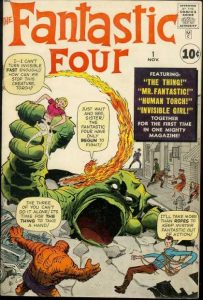
Fantastic Four (1961) 1
When super heroes first graced the four-color pages of comic books, they hailed from Metropolis and Gotham and Central City. Granted these cities were modeled after real-life counterparts, but they were still fiction.
Young Joe Shuster and Jerry Siegel envisioned their hometown of Cleveland as Metropolis. Gotham was New York City, but with an alias.
And, so on.
When Stan Lee wanted to settle his first heroes, the Fantastic Four, he looked around him and saw New York City. So, the FF lived in NYC. Pretty much all who followed did too.
If they didn’t live in the city, they lived close by.
Over time other titles showcased different parts of America, but New York was always the birthplace for Marvel’s heroes. This is why the Fantastic Four represent National New York Day. They were the first to call the sprawling metropolis home. It has been the backdrop to many adventures and refuge after all of them.
Again, today is not about the city, but the state as a whole. Remember the 11th state for its history, elegance and grace, but mostly for the heroes who call it home.
Incredible Hulk (1968) 420
This is a day most people don’t want to recognize. Today reminds people they should still be afraid. Afraid and careful.
Today, Sept. 18, is National HIV/AIDS and Aging Awareness Day. Today is a day to focus on the number of persons infected who are living longer lives with HIV/AIDs. An estimated 1.2 million persons are HIV infected in the United States. Of those, around 24 percent are 55-years of age or older.
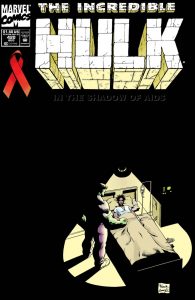
Incredible Hulk (1968) 420
The day is designed to focus on a dark reality, too. The campaign hopes to make others aware of the growing number of grandparents who are primary caregivers of children who have lost parents to HIV/AIDS.
Incredible Hulk issue 420 was casually released to readers with little warning. Just a red ribbon and grim cover belied Peter David’s Lest Darkness Come inside.
Making his final appearance is long-time Hulk friend Jim Wilson. He had been revealed as HIV positive in Incredible Hulk 388. Issue 420 is his swan song, dying from complications arising from AIDS.
Betty Banner plays in a separate scenario as she works to stop a suicide attempt by a young man diagnosed as being HIV positive. Her attempts are met with tragedy as the man ends his life while selfishly keeping his secret from his girlfriend.
The letter’s page is forgone for the issue allowing comic industry pros: Michael Kraiger, Nicholas J. Vance, Barbara Slate, Jeph Loeb, Joe Rubinstein, Mindy Newell, Chris Cooper, Gary Guzzo, Don H. DeBrandt, Tom A Tenney and Kelly Corvesse a chance to voice their stories and feelings about the ongoing battle.
An estimated 74.9-million people have been infected with HIV since the disease first began taking victims in 1981. Since then, 32 million have died of AIDS-related illnesses. In 2018 alone, 770,000 people died of AIDS-related illnesses.
The National Institutes of Health launched National HIV/AIDs And Aging Awareness Day in 2008. To become more involved, visit The AIDS Institute.
Blue Monday (2000)
Welcome to Blue Monday.
What is Blue Monday?
Blue Monday is mathematically the most depressing day of the year.
In 2004 Cliff Arnall, a tutor at the Center for Lifelong Learning, declared the third Monday in January the day we as humans in the northern hemisphere feel the lowest. The holidays are over, sunlight is at a premium and the winter lay ahead.
Arnall even calculated why we feel so “blue”: [W+(D-d] x T^Q} – [M x N_a] with “W” standing for weather, “D” standing for debt, “d” standing for monthly salary, “M” for motivational levels and “Na” standing for the need to take action.
According to the Holidays Calendar, this has since been debunked and attributed to a promotional travel campaign by Sky Travel.
No matter, Four Color Holidays is accepting Blue Monday as an official non-holiday.
Blue Monday (2000) The Kids Are Alright
Representing such is the comic book Blue Monday, taken from the song Blue Monday. Not the Blue Monday as crooned by Fats Domino or the White Lion tune penned in 1991. The Blue Monday in question is by the post punk scene group New Order released March 7, 1983 as a 12-inch single. Over three million copies were sold.
Our Blue Monday was created by Chyynna Clugston Flores chronicling the exploits of the loosely based avatar Bleu L. Finnegan and her high school friends in the early 1990s.
Flores published one-page dramas and short stories in Dark Horse Presents, Action Girl Comics and Oni Double Feature from 1997 to 2000. As the new millennium dawned, Flores saw her creation expand and Oni released a mini series called The Kids are Alright. It was followed by three more over the next five years and one-shot in 2009.
After a six-year hiatus, Blue Monday was given a new life at Dark Horse. The Kids Are Alright appeared in 2016 followed by Absolute Beginners that December and In between Days in July of the following year. Painted Moon was solicited, but never shipped.
Flores hasn’t given up on her wayward cast of misfits, promising to continue their exploits post high school and into young adulthood.
Whatever the fate of Blue Monday the comic book, we can choose to embrace the non-holiday either by wallowing in the miasma of day with sad music, staying home and refusing solace. Or, we can battle back the blues with some creature comforts.
However you celebrate/commiserate, maybe check out these books; what’s a little more debt this time of year?