

Archive for the ‘DC Comics’ Category
Brightest Day, Blackest Night (2002)
Before television, before Internet, there was radio.
Radio was, literally, the voice that captured imaginations, entertained the masses and informed the world.
Today radio is more relegated to vehicles.

Brightest Day, Blackest Night (2002)
If Gugliemo Marconi couldn’t visualize what his creation was to become, neither could Nikola Tesla, who demonstrated the first radio in 1893. Hard as it may be to believe, radio wasn’t first envisioned as a communication device. It took many minds and hands to determine a functional use for the invention.
Lee de Forest made the first public transmission via the new device in 1910. In 1920, the first radio news program was broadcast out of Detroit, MI.
All of this has led to National Radio Day. Our host is Golden Age Green Lantern alias and radio announcer Alan Scott.
The 2002 Brightest Day, Blackest Night one-shot pre-dates the zombified and reunified titles of the later part of the decade.
This flashback showcases Scott and his golden oldie persona battling Nazis and Solomon Grundy at the behest of the Justice Society of America.
Radio station WGAH plays a minor character in the opening act setting the stage for the drama to come.
Scott was introduced in the pages of All-American Comics issue 16 in 1940. His skimpy eight-page introduction to the comic book reading universe was given the nod by legendary four-color pioneer Max Gaines.
Green Lantern would quickly become a member of the Justice Society and given a sidekick, taxi driver Doiby Dickles. Their exploits would continue to 1949 when disinterest in the mystery men would shelve the character for 12 years.
Radio would endure, even if Green Lantern would not – at least for a short publishing period.
Currently it is estimated 71 percent of the driving public listen to the radio while in their vehicle. At least 67 percent listen on a daily basis. Of those, 48 percent admit to singing along to the music broadcast; over half of them being women.
Today, turn on, tune in and drop the pretense: it’s National Radio Day. Spin the dial and find a good soundtrack for Brightest Day, Blackest Night.
The Joker’s Joke Book (1988) Tor
For the music lover today marks the 45th anniversary of Elvis’ death. For the non-holiday enthusiast, today is National Tell a Joke Day; not to be confused with International Joke Day which is July 1.
It is thought jokes have existed as early as 1900 B.C. Palamedes is often cited as the grandfather of the joke, outsmarting Odysseus in the Trojan War. That’s just a theory, but as good an origin for the joke as any.
If the birth of the joke is a mystery, so is National Tell a Joke Day.
Eighteenth-century Cornish-born Samuel Foote is considered the first stand-up comedian. His troubled early life led him to London, England, where he became a fixture of coffee houses. Using his natural talent for impersonation and quick wit, Foote was dubbed The Coffee House Comedian.
He would die of a stroke in 1777.

The Joker’s Joke Book (1988) Tor
Since then, many have followed in his footsteps.
Our emcee is not so much a joker by profession, but in name.
Created by Bill Finger and Bob Kane, the Joker of the DCU first appeared in Batman issue one, April 25, 1940.
His origin has been told and re-told, created and re-created. Just as his persona.
In the beginning there was a psychopath. The Joker would later be dumbed down to placate an audience that didn’t even read comic books. As mores changed, he would return to his murderous ways, in a chilling full circle.
By the late 1980s word of a major motion picture starring the Dark Knight and featuring his grinning nemesis unleashed a tsunami of merchandise.
Mort Todd, writer, illustrator, filmmaker, editor and publisher, brought The Joker’s Joke Book to the mass market in 1988.
Todd has a pedigree ranging from comic books to the music industry, drawing album covers, directing music videos and producing music. He launched Marvel Music at Marvel Comics, personally working with such artists as Mick Jagger, Gene Simmons, AC/DC and the estates of Elvis Presley and Bob Marley.
The 128-page paperback retailed for $1.95 featuring funnies your father would tell on a Sunday drive to church.
Today the book can be found on most of the primary secondary markets. Finding an audience may be harder.
All-Star Western (1970) 10
His star may have faded over the decades, but America is still defined by the rugged, jeans wearing, dusty booted, low-slung gun belted image of the cowboy.
Today we celebrate with National Day of the Cowboy.
Putting a face to the day is DC’s pale rider, Jonah Hex.

All-Star Western (1970) 10
Hex first appeared in a full-page house advertisement in several of National Periodicals (soon to be rechristened DC Comics) November/December 1971 cover-dated war comics and a half-page spread in Batman (1940) issue 237.
His debut came in February/March of 1971 in the aforementioned All-Star Western issue 10. It would be retitled Weird Western Tales two issues later where Hex would reside as the headliner through issue 38.
Hex’s self-titled series began in 1977, running a total of 92 issues. It met its doom with the rest of the DC Universe in Crisis on Infinite Earths in 1984.
He would be resurrected the following year in the simply titled Hex. The book ran a total of 18 issues with the title character molded more in the Mad Max vein as he trekked through a post-apocalyptic 21st century.
Hex would appear in three mini-series during the 1990s under the Vertigo imprint. He would earn a second series in 2005 running 70 issues. The book would be cancelled and Hex moved to All-Star Western (2011).
Beyond the comic book field, Hex has appeared in animated form in Batman: The Animated Series, Justice League Unlimited, Batman: The Brave and the Bold and Justice League Action.
A feature film was released in 2010 to lackluster response. The commercial failure grossed $11 million on a $47-million budget.
National Day of the Cowboy began in 2005 when the organization sponsored a bill in the Wyoming House and Senate to commemorate cowboy culture and history in the state. To date, 15 states have passed the same bill.
The plan is to have a bill passed in all 50 states.
To celebrate, attend a rodeo, study cowboy culture or simply dig out some of those dogeared four-colored westerns, open a can of beans and dust off the cap gun.
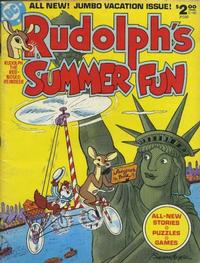
All-New Collectors’ Edition C-60
Even if lawns have already been mowed, pools filled and travel plans made, today is officially the start of Summer.
Rudolph is a fish out of water as he and Grover hit The Open Road (Act One) for a vacation.
The top is always down for the duo as they pedal their way across the USA on a bicycle built for two. The difference being this two-wheeled conveyance is propelled by a propeller allowing them a bird’s eye view of their trip.
All-New Collectors’ Edition C-60
All is well until they meet fellow traveler Mr. Cat. The felonious feline fleeces his new-found friends, but is brought into the fold by Rudy and Grover who forgive and forget.
Mr. Cat joins them as they pedal their way to New York City to see the Statue of Liberty. They lose their companion while Rudolph earns a commendation for seeing a ferryboat to safety during a storm.
Homeward Bound…But… is the final act with the two on a sailboat.
The famous reindeer is detoured by a well-meaning fan to visit other admirers on Animal Island.
The warm welcome is brought to an abrupt halt by an ongoing war when both factions confront each other. Rudolph is able to defuse the situation and set matters right.
With yet another medal strung around his neck, Rudolph steers he and Grover north and home.
Readers are treated to eight pages – and the back cover – of fun and games. First up is a game repeating the hero’s ocean voyage.
Other fun stuff includes Grover and friend demonstrating a paper trick, story participants tell jokes and riddles, readers must find Grover’s twin, more paper tricks, a quiz game, directions on how to build a periscope, connect-the-dots and coloring page.
The outside back page offers a table-top diorama like many of the previous Limited Collectors’ editions. This one features the statue of liberty with Rudolph and Grover on their chopper bike.
Tiny Titans (2008) 27
Happy Father’s Day.
Sit back, relax and wait for the coals to warm before tossing on the red meat of choice as the male population – with one or more children – celebrates its day.
Sonora Smart Dodd is the founding father with the day commemorated the third Sunday of June.
This year Four Color salutes the harried husbands who work through the day and still find time to play in the evenings. Who bring home the bacon, sometimes even frying it up in a pan, and never, never letting anyone forget they’re a man.

Tiny Titans (2008) 27
Taking the spotlight for 2022 is Teen Titan Raven’s father, Trigon.
First introduced, in a cameo, in New Teen Titans issue two, he made his official, first full appearance in New Teen Titans four.
The Marv Wolfman/George Perez creation is a demon from an alternate dimension. He mated with Raven’s mother, Arella, as part of a ritual for the Church of Blood. Their pairing produced a child with empathic powers.
While Trigon is a less than perfect example of what a father should be, he was highlighted in issue 27 of the Tiny Titans. The June 2010 cover-dated issue serves as a Father’s Day issue for us.
The premise for the issue has Raven as a reluctant babysitter for Kid Devil. Kid Devil was originally a Blue Devil wannabe.
Anyway, Raven must wrangle the bitty demon. Trigon finds the miniature hell spawn adorable and offers to help. The weekend becomes a series of one- and two-page jokes as Trigon appears much like the domesticated fathers of the 1950s sitcoms.
Kid Devil is returned to Blue Devil and all ends well.
Tiny Titans is the creation of Art Baltazar and Franco Aurliani, running 50 issues. It was honored with the Eisner Award for Best Series for Kids twice, in 2009 and 2011 respectively. As described on Wikipedia, “Tiny Titans stars alternate versions of DC Universe Characters, primarily those from the Teen Titans series. It is set in a kid-friendly, elementary school environment. Issues typically consist of several individual stories as opposed to one cohesive storyline.”
Again, Happy Father’s Day. Don’t forget the reason for the day. They grow up too fast.
Swamp Thing (1972) 2
Welcome to National Sewing Machine Day.
What tailors and seamstresses did by hand for centuries was brought into the pre-industrial age when Thomas Saint filed and received the first patent for the design of a sewing machine in 1790. While designed to sew leather on canvas, no actual machine has ever surfaced.
William Newton Wilson saw the English inventor’s designs in the London Patent Office. With a few deft drafts, he was able to produce a working model. It is on display at the London Science Museum.
Swamp Thing (1972) 2
John Greenough received the first American patent for the sewing machine in America, but it was Isaac Singer who developed what is more recognizably the modern sewing machine.
While taken for granted today, the sewing machine proved invaluable. Not only did it help with production of clothing thus dropping the price, it was also a major mover in the industrial revolution allowing sewing to be done in factories,
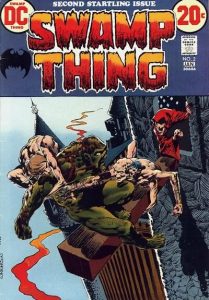
While a handful of visionaries are responsible for today’s machine laureate, our emcee is the work of two men. Len Wein and Bernie Wrightson created the Patchwork Man in Swamp Thing (1972) for issue two.
He only appeared in the final panel of the book, but was the thrust of the story for issue three.
Readers learned Gregori Arcane had been dismantled by a land mine. His mad scientist brother, Anton, gathered the pieces and sewed them back together. With science and sorcery, he was able to return life to Gregori.
A second Patchwork Man resides in the DCU. This one is Marine, Pvt. Elliot “Lucky” Taylor. He, too, was killed by a land mine, but was reconstructed by Doctor Mazursky and his team of surgeons and scientists in Project M. He became part of the experimental Army unit, the Creature Commandos.
His first appearance was in Weird War Tales (1971) issue 92 entitled The Creature Commandos.
While we know how the Patchwork Men came to be, we do not have the origins of National Sewing Machine Day.
Rather than worry about that, celebrate by sharing tips and tricks, post photos commemorating the day or hang out in your favorite sewing-related shop.
We might suggest you cobble together your own Patchwork Man suit for a little cosplay.
Just a suggestion.
Feature Comics (1939) 27
Today we are asked to remember a simpler time and a simpler toy for a message of love and happiness.
The second Saturday in June has been designated World Doll Day, as founded by Mildred Seeley. In a chain letter of sorts, Seeley asked each of the persons she contacted to tell five people and they in turn tell another five about her project. The inaugural event was held June 14, 1986.
While many fondly remember having a “friend” growing up, there are many more who might not have the same opportunity. Though the day began as one of remembrance, it has become a day of giving as well. Those celebrating may wish to give a gift of a doll especially to a child who does not have one.
The toy itself may not have always been a toy.
Feature Comics (1939) 27
The earliest dolls were found in Egyptian tombs as long ago as 2000BC. Their intended use is unknown, but some cultures believed dolls possessed magical powers.
Dolls were originally made with wood. They have also been made from soapstone and bone, dried apples, corn husks, clay and stone. Porcelain is highly prized for the manufacture of dolls.
Putting a face to the day is an unlikely hero who first appeared in the Golden Age of comic books.
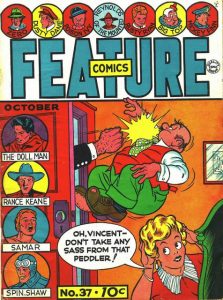
Doll Man debuted in Feature Comics issue 27 in 1939 for Quality Comics. Darrel Dane was coined The World’s Mightiest Mite after concocting a formula allowing him to shrink to six inches while retaining his full strength.
The Mite was popular enough he became the featured character through the title’s run ending with issue 139 in 1949. Doll Man’s self-titled book ran 47 issues, ending in 1953.
National Periodicals, later DC, purchased Quality Comics’ characters when the company went out of business in 1956. It wasn’t until 1973, in Justice League of America issue 107, he returned as part of the Freedom Fighters from Earth-X.
Freedom Fighters received its own book from 1976-78, running 15 issues.
He would then be moved to Earth-2, which was destroyed during Crisis on Infinite Earths.
Post crisis has not been kind to Darrel who is sometimes referred to as Darryl. He would not be seen again until 2006 when The Freedom Fighters were resurrected under Uncle Sam and the Freedom Fighters. Readers learned the years of shrinking had caused brain damage, leaving Darrel/Darryl Dane, aka Doll Man, mentally unstable.
Not content to allow a valuable property to lie dormant, DC revamped Doll Man under the persona of Lester Colt as witnessed in Crisis Aftermath: The Battle for Bludhaven.
He was further transformed at the dawn of The New 52, this time as Dane Maxwell. He costarred with the Phantom Lady in a mini-series having no roots to his previous incarnations.
No matter what, enjoy the day. If so inclined, have a tea party with friends and dolls, but if you’re male, make sure they are referred to as action figures.
Green Lantern (1959) 76-87 and 89
After a cloistered past coupla years, Americans are ready to hit the roads once more. Today is the day to do so.
Today is National Road Trip Day.
National Road Trip Day is the Friday before Memorial Day, the official kickoff to the summer road trip season.
Our official travelers are the “hard-traveling heroes” Green Lantern and Green Arrow. The pair bid farewell to the end of the Silver Age and the 1960s as they discovered America, faults and all, for a celebrated 14-issue run chronicled by Denny O’Neil Neal Adams.
The term “hard-traveling heroes” wasn’t coined until the early 1990s when their exploits were first reprinted in the burgeoning trade paperback genre. They had first been reprinted in the Paperback Library version of Paperback Comics in 1972. The book featured black and white reprints of Green Lantern (1959) issues 76 and 77.
That same year a second volume, in the same format, was offered featuring reprints of issues 78 and 79.

Green Lantern (1959) 76-87 and 89
In 1983, DC reprinted the issues in what has been termed as the Baxter series. The seven-issue run offered two issues per book, completely reprinting the original storyline.
The “hard-traveling heroes” were the brainchild of writer Denny O’Neil. DC editor Julie Schwartz offered him the floundering character allowing the writer carte blanch to boost sales.
O’Neil returned the space-faring policeman of sector 2184 and rooted him on Earth in the dying counterculture movement of the previous decade. With liberal Oliver Queen, aka, Green Arrow, they shared experiences and differed in opinions as they traversed the highways and byways of America.
False sales figures brought their adventures to a premature close with issue 89, but the storyline peaked with issues 85 and 86. Those featured Arrow’s teen sidekick and sometime Teen Titan, as a heroin addict in one of the first serious looks at drugs in the pages of comicdom.
At times the story telling was heavy handed, but the tales were recognized beyond comic book pages by The New York Times, The Wall Street Journal and Newsweek.
Now, plot a course for your own adventure or relive part of comic book and American history. Either way, you won’t be disappointed.
Justice League of America (1960) 43
National Solitaire Day celebrates its inaugural anniversary today, courtesy of Microsoft and all those participating in the card game that’s already passed its bicentennial birthday.
Solitaire, or Klondike, features an addictive play utilizing all 52-playing cards. Participants are challenged to arrange those 52 cards from lowest to highest in the four different suites for victory.
It can also mean any tabletop game played by one person, sometimes even including dominos. For our purposes, we’re using the solitaire everyone knows.

Justice League of America (1960) 43
Microsoft first included a digital version of the game with its Windows 3.0 version. In addition to creating a craze, it aided people in the use of learning how to manipulate the mouse and became the most played video game in the history of computers.
Representing the four-color community is the Royal Flush Gang.
These card suited villains were first introduced in Justice League of America (1960) issue 43. Using a playing-card based theme, each of the members used a codename based on the cards needed to form a royal flush in poker: Ace, King, Queen, Jack and 10.
The original gang only appeared twice. A second Royal Flush Gang debuted in Justice League of America (1960) 203 as part of Hector Hammond’s devising. Their motif was the house of Spades.
A third gang surfaced in the post-crisis DC Universe. Rather than decking themselves in all the same suit, this group chose to utilize hearts, clubs and diamonds as well as using codenames from the lower cards.
With the advent of the New 52, the Royal Flush Gang returned in the Forever Evil storyline. They would resurface in DC’s Rebirth period as well.
Solitaire is believed to have been created sometime in the late 1700s in northern Europe.
While Klondike Solitaire is the most commonly recognized version, other popular interpretations include Spider, Yukon and FreeCell.
Of course, the most common way to celebrate the day is to grab a deck of cards or mouse. When you’re frustrated enough with that, grab a vintage Justice League or variation and give the criminal cards a read.
Django Unchained (2012) 1
Neither today’s non-holiday nor the accompanying “funny” book are pleasant topics.
Slavery Remembrance Day – or, International Day for the Remembrance of the Slave Trade and its Abolition – is observed on August 23 worldwide. Today has been chosen by the United Nations Educational, Scientific and Cultural Organization (UNESCO) to remember the transatlantic slave trade.
Django Unchained (2012) 1
Today is a day to commemorate the over 15 million men, women and children uprooted from Africa to be abused as slaves in a practice that lasted over 400 years. The slave trade began in the 15th century with the Portuguese as the first slave traders. Slaves were supplied to America from Africa and paid for by Europe.
Slaves first arrived in what would become the 13 colonies in 1619 in Jamestown, VA.
The first Slavery Remembrance Day was celebrated in Haiti in 1998.
August 23 was chosen due to its importance in deposing the trade. On August 22 to August 23, 1791, the first major slave uprising during the transatlantic slave trade happened in Saint Domingue in modern-day Haiti.
Dubbed the Haitian Revolution, it became a 13-year struggle lasting until 1804 when the natives wrested control of their island from French colonists.
America’s slave trade would not end until 1865 with the War Between the States.
Director Quentin Tarantino turned his eye to the old west in 2012 with Django Unchained. His Oscar winning movie focused on escaped slave and title character played by Jamie Foxx.
Django and bounty hunter cum savior Dr. King Schultz would spend the remainder of the movie searching for Django’s still enslaved wife.
Django Unchained would earn five Golden Globe Award nominations, but would go on to earn the Oscar for Best Original Screenplay.
The movie would earn $425 million on a $100 million budget and be Tarantino’s highest grossing movie to date.
DC’s seven-issue comic book adaptation was released to compliment the film, running through September of the following year.
Slavery continues to this day with an estimated 40 million people affected worldwide. Modern slavery is most prevalent in Africa, Asia and the Pacific.