

With a Little Help From Some Friends
Yesterday the Hulk helped explain the tradition of hanging stockings on the fireplace, Today his cousin, She-Hulk, will explain how elves came to work for Santa.
These diminutive helpers began as a hearty and beefy lot of Germanic and Norwegian heritage. Later they were wed with European sprites or gnomes who offered help to farmers.
‘Twas the Night Before Christmas introduced elves into Victorian folklore by describing Santa as one. Later, Harper’s Ferry featured a poem, The Wonders of Santa, that mentioned elves helping the fat one that continued to build on the myth.

Not Spock ears
In 1873 Santa was portrayed surrounded by elves on the Christmas cover of Godey’s Lady’s Book which offered an early visualization.
By the 20th century, the concept was cemented enough main stream artists like Norman Rockwell and others put brush and oil to canvas to further the legend. Today the belief is almost fact


Based on a True Story
Hanging stockings by the fireplace is a story that has evolved over centuries until, now, a jolly fat man puts presents in them each Christmas Eve.
Based on the generosity of real life St. Nicholas, the tradition allegedly began in the fourth century. Nicholas, the Bishop of Myra, was a Turk of some wealth. Legend has it he would gift the needy, not just one night a year, but when needed.
How, then, did this transfer into stockings by the hearth?
The story has St. Nicholas helping a man of little means with three daughters who he had no dowry for. The tradition of the times dictated to be married, women must enter the marriage with something of value.
So the daughters could marry, Nicholas was to have dropped gold coins down the chimney. The coins supposedly landed in stockings and so began the tradition.
Join Hulk as he perpetuates the legend.


The Color(s) of Christmas
Deadpool makes with a beefcake pose as he sports his green cap and usual red togs making with the Christmas colors.
Of all the hues in the color spectrum, only a few symbolize the holiday and only two are unmistakably Christmas.
Red and green date back to pre-Christmas and solstice. Celtics believed holly wreaths brought prosperity and good fortune. The colors continued even after the plants became nostalgia.
For the believer, the wreath became symbolic of the “crown” of thorns forced on Christ’s head prior to his crucifixion. The red symbolized the blood spilt.
In the 1930’s, the Coca-Cola company commissioned Michigan-born artist Haddon Sundblom to create a (then) modern Santa Claus. His red suit mirrored the Coke can while green lettering spelled out ad copy.
In addition to red and green are gold, blue and white. Gold represents the gift to the Christ child, blue Mother Mary’s robes and white the purity of Christ.


Candy or Decoration?
Does anyone really eat candy canes.
Apparently so. Candy canes are the number one selling, non-chocolate candy in December. One point seventy-six billion are manufactured annually with 90-percent of them sold between Thanksgiving and Christmas.
The bulk of those are sold the second week of December.
Now, how many are eaten and how many are used for decoration is debatable.
Originally, candy canes – or their fore runners – were created to silence choir boys.
The choirmaster of the Cologne Cathedral in Germany would dispense the confectionary treats during the Living Crèche Ceremony. The tradition that began in 1670 migrated to the United States with August Imgard of German and Swedish descent in 1847. Wooster, OH, had the honor of of hosting the occasion.
The red stripes and peppermint flavoring were added at the turn of the 20th century.
Today Catwoman sports her Jim Lee designed costume that debuted in the Hush story arc complete with candy cane.


Milk and Cookies
And, what would the holidays be without traditions?
One of the most endearing is leaving cookies and milk out for Santa.
While the roots of confection and dairy go back centuries, our current habit is less than 100 years old. Children in the 1930s were taught gratitude for gifts as they Great Depression ravaged the American economy.
Batgirl keeps the jolly one full of sugar with her Christmas offering.

Milk and Batcookies


Advent Calendar 2025
Let’s have a little Funko fun for the holidays this year. Presented for your gratification are an advent calendar of holiday themed heroes designed to inspire some Christmas cheer.
Kicking off the season is Captain America bundled up to ward off the deep freeze that has settled across much of the United States east of the Mississippi.
Brrrr.
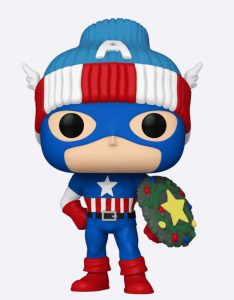


Tomb of Dracula 41
Though the day dawns bright, it will quickly surrender to the darkness that blankets us earlier and earlier with the passing of each day. Soon, it will be Winter and time for other holidays, but there’s time enough for that.
Today is October 31. Today is Halloween. Tonight the Witching Hour will chime before midnight as young and old disguise themselves in horror and spectacle. Some for candy, some for their own amusement.
Just enjoy what comes and allow our host, the King of Vampires, to begin they day.
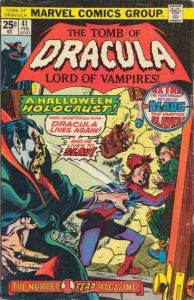
Tomb of Dracula 41
Still recovering from a bigger dread than any of the serialized monsters of old that would populate Marvel’s own magazines, the company moved from under the shadow of the Comic Code. First, in black and white magazines outside the authority of the Authority. Then, as the CCA’s hold weakened, into the pages of the four-color books it once neutered.
Werewolf by Night first howled in defiance under the banner of Marvel Spotlight issue two. Jack Russell would wolf out for three tryout issues before moving to his own title, but it was Tomb of Dracula that would outlast the full moon curse.
He would extend his stay on the spin rack for 70 issues; the longest tenure of any villain from any comic book company. Longer Than Dr. Frankenstein’s namesake – he only saw print for 15 issues.
Longer than The Living Mummy who remained a staple of Tales of Suspense, never earning his own title.
Dracula’s original story at the House of Ideas has been told many times. In a quick recap, the Lord of Vampires stumbled for several issues until Marv Wolfman began to shepherd his way with issue seven.
Gene Colan drew every issue of the main title. The journeyman penciler did break rank for a few issues midway through the book’s run, but quickly returned. Colan’s penchant for working several issues ahead allowed him to retire and unretire from the title without anyone outside the comic book field knowing.
For most of the decade the book remained within its gothic universe with the exception of guest star the Silver Surfer intruding for issue 50. Dracula ventured into the main stream Marvel Universe a few times; guesting in Giant-Size Spider-Man, Doctor Strange and the Uncanny X-Men.
Maybe his oddest cameo was in the Howard the Duck Magazine issue five.
While dated, the books still read well. To pay homage to the title here is the cover of issue 41, a true Halloween tale to celebrate the final day of October.
Enjoy and be safe.


What’s Up, Doc?
Marvel was branding in the 1960s.
Daredevil, Red Skull, Cap, Mr. Fantastic. And that’s just Halloween costumes.
So far we’ve looked at Daredevil and Red Skull. Today, let’s explore the supernatural with Master of the Mystic Arts.
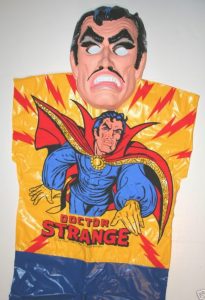
Ben Cooper Doctor Strange
Created by Steve Ditko, Doctor Strange made his comic book debut in Strange Tales 110. Sharing the book with the Human Torch, Strange and the flaming teenager would alternate top billing each month. His origin wasn’t revealed until issue 115. Acting as the script writer using plots by Ditko, Stan Lee based Strange on the 1930’s Chanda the Magician radio show.
With a new distribution deal, Marvel was allowed to publish more books. That allowed Strange to take over the whole book with issue 169. His solo exploits ran to issue 183. He would go on hiatus until 1971 in Marvel Feature with a three-issue story arc.
He would next be featured in Marvel Premiere in issues three through 14.
Strange’s popularity grew to allow him his own title, Doctor Strange: Master of the Mystic Arts, that ran 81 issues. Cancellation of that book led to a second volume of Strange Tales shared with newcomers Cloak and Dagger.
The good Doctor would earn his own self-titled book in 1988 with Doctor Strange: Sorcerer Supreme. It would be lumped in with Marvel’s Midnight Sons family of supernatural books. Following that, Strange would again guest-star in one-shots and limited series and served in supporting roles for the beginning of the new millennium. By 2010, he would be part of The New Avengers.
As with most heroes, Strange would have to suffer his own death only to be brought back in dramatic fashion.
Of course, he would later be launched into the MCU with his own feature film.
So, don’t be too harsh judging this early cosplay, what do you expect for a couple bucks?


Red, Dead and Redeemed
One of the scariest tropes of Halloween is the skull. Add some red, and you’ve got today’s guest of honor in our countdown to the 31st.
The Red Skull first appeared in Captain America Comics issue one in 1941 – less than a year before we entered the war. The Timely Publication is probably better known for its intro of the titular hero, but tossing in his greatest nemesis didn’t hurt.
The Red Skull made his first – and last – appearance in that same issue. Or, what was supposed to be his last appearance. By story’s end, Red Skull had committed suicide.
His demise was greatly exaggerated as Red Skull would return in book three. Only to die again. This time by hand grenade.
Just as his first death was a sham, so was his second. Red Skull made his third appearance in Cap number seven. Following, he would moonlight in other titles as the 1940’s waned. His last Golden Age appearance would be in the final issue of Captain America, by then titled Captain America’s Weird Tales reflecting the growing in horror books.

Red Skull
After an absence of five years, the Red Skull would guest in 1954’s Young Men Comics issue 24. The story, Back From the Dead, would serve up a more materialistic Skull as he headed up a common criminal adventure only to die – again.
The Red Skull rested in peace just a hair over a decade before returning in Tales of Suspense issue 65. This return to World War II saw Cap and Skull duke it out Jack Kirby style in the Silver Age. His reappearance was explained away by using the ol’ double saying there were two prior and the other died. The current Skull had been frozen in suspended animation only to be revived to continue his battle against the first Avenger.
Since that time, the Red Skull has guested off and on throughout the Bronze, Copper and Modern Ages. His notoriety has earned him spots outside the four-color world on both big and small screens.
Here the old man has been immortalized by Ben Copper as a costume choice. Makes ya wonder how many outside the comic book community recognized him.


Eye of the Beholder
The uglier the better. The more spirit it shows, the more fun it symbolizes.
Ugly Christmas sweaters began as an accompaniment to entertainers like Pat Boone, Andy Williams and Bing Crosby as we invited them into our homes during early televised holiday specials.
They would be adorned with festive bells to compliment reindeer and Yule tide trees that decorated the woolen eyesores.
As the 1950s became the turbulent 60s and Me decade that followed and fashion mirrored the technicolor now invading living rooms via the cathode ray tube, so did the sweaters.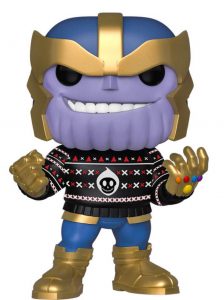
By the 1980s, these same festive fashions were revealed for what they truly were: gaudy accessories. Maybe 1989’s Christmas Vacation outed the long held secret.
With the new millennium came a honesty. Wearers admitted these abominations were just that and reveled in the truth. Ugly Christmas Sweater parties were hosted and prizes awarded to the crowd favorite.
Join Thanos in the fad cum tradition.